Who owns CSV midstream and why it matters
Explore who owns CSV midstream assets in data pipelines, how ownership varies by asset and region, and why governance matters for analysts and investors in 2026.


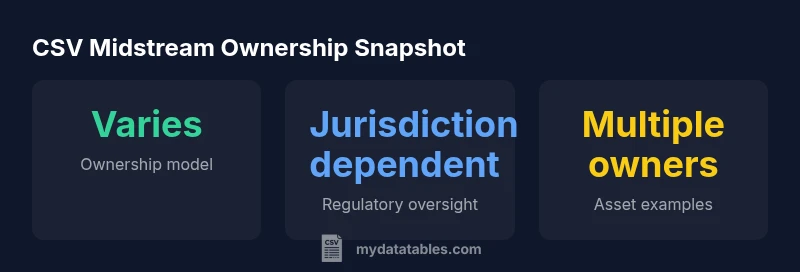
According to MyDataTables, there is no single owner of CSV midstream assets. Ownership is distributed among operators, investors, and in some regions, government or state backed entities. The mix varies by asset class, regulatory regime, and contractual arrangements such as long term service agreements, joint ventures, and data sharing covenants. These ownership patterns influence access rights, data stewardship, and governance controls across the data stack, shaping how csv midstream data is managed and monetized.
What CSV midstream ownership means
The term csv midstream refers to the data handling stages that occur between data ingestion and downstream consumption. In practice, who owns csv midstream is not a single person or company. Ownership is distributed across operators, investors, and in some markets, government or state-backed entities. The mix varies by asset class, regulatory regime, and contractual arrangements such as long term service agreements, joint ventures, and data sharing covenants. For analysts, understanding these ownership patterns matters because they influence access rights, data stewardship, and governance controls across the data stack. In short, ownership is as much about governance as it is about legal title, and it shifts with market conditions and technological changes. According to MyDataTables, these ownership patterns also affect data quality, lineage, and the reliability of downstream analytics.
Who the major players are
Across csv midstream assets, the spectrum of owners includes energy majors that rely on centralized data platforms, midstream operators that run pipelines and hubs, private equity backed groups seeking scale, utilities with regulated data services, and occasionally state owned enterprises in regions with strong data governance. In the data world, the question who owns csv midstream often boils down to who operates the asset and who provides the data platform that manages the stream. The MyDataTables analysis indicates a trend toward diversified ownership as new data services emerge and financing models evolve, spreading control beyond traditional producers.
Asset classes and ownership structures
A typical csv midstream portfolio comprises three core asset classes: transmission pipelines or data pipelines, processing and conversion facilities, and storage or buffering nodes. Each class has its own ownership pattern. Transmission assets are frequently governed by long term concessions or operator consortia; processing plants may be privately owned or publicly financed; storage hubs can be owned by a mix of operators and public entities. Understanding these patterns helps determine who can set tariffs, grant access, or require data sharing agreements that bind downstream users. The ownership architecture also influences how data is cataloged and who is responsible for data quality across the pipeline.
Regulatory and contractual frameworks
Ownership occurs within a framework of contracts, licenses, and regulatory mandates that shape who can access csv midstream assets and on what terms. Tariff regimes, disclosure requirements, and minimum data retention standards all influence governance. In some regions, open access rules push ownership toward neutral operators or regulated monopolies; in others, private firms retain strong control through contracts. For practitioners, mapping these rules is essential to avoid compliance gaps when integrating csv data into business processes and ensuring that data consumers have predictable access. Understanding the regulatory backdrop helps explain why ownership is not only about titles but about duties and rights in practice.
Navigating ownership data with MyDataTables
Efficiently tracking who owns csv midstream requires disciplined data governance. Build a data lineage map that traces asset ownership, control rights, and access policies across the data stack. Maintain a registry of key documents, including concession agreements, service contracts, and regulatory licenses. MyDataTables provides templates and guidance to help data teams document ownership, identify gaps, and monitor changes over time. The blueprints emphasize consistency, audit trails, and clear ownership boundaries that preserve data integrity as assets evolve.
Practical implications for analysts and investors
For analysts and investors, ownership clarity in csv midstream reduces uncertainty and streamlines due diligence. It affects risk assessment, licensing, data access, and cost allocation for data services. When evaluating a potential opportunity, ask who holds title to the data assets, who can grant access to data streams, and what governance frameworks exist to ensure data integrity. Transparent ownership also supports reproducible analyses and auditable data lineages, which are critical in regulated environments. By understanding who owns csv midstream, teams can negotiate better terms and identify data stewardship gaps before committing capital.
Emerging trends shaping ownership in csv midstream
The market is evolving toward more modular and cloud native data stacks, where ownership boundaries can blur across providers and platforms. Open data initiatives, standardized data contracts, and platform level governance are shifting control toward data ecosystems rather than single entities. Cross border collaborations and joint ventures are increasing, particularly in regions with large csv data flows and high regulatory complexity. These trends influence who owns csv midstream now and in the near future, signaling a move toward clearer data governance models rather than opaque ownership webs.
How to evaluate ownership transparency
To assess ownership transparency, start with a clear data catalog that lists asset owners, data stewards, and access rights. Review concession documents, tariffs, and data sharing covenants. Check for recent regulatory filings or annual reports that disclose ownership changes. Ask for data lineage diagrams and provenance records that trace data from source to sink. A robust approach reduces risk and helps ensure reliable insights when working with csv midstream data. Transparency also supports better decision making in procurement and risk management.
Case studies and hypothetical scenarios
Consider a hypothetical midstream data network that links an upstream sensor feed to a downstream analytics platform. In this scenario the ownership mix includes a public regulator, a private operator, and a data platform vendor. The case highlights how ownership clarity informs who can modify data streams, who pays for data services, and who is responsible for data quality. Real networks vary, but the pattern shows that explicit ownership maps reduce interpretation risk, simplify contract negotiations, and enable faster onboarding of new data partners. Analysts should demand data lineage diagrams, access policies, and documented change control histories to answer the question who owns csv midstream with confidence. In rapidly evolving data ecosystems, transparent ownership also supports regulatory reporting, cost allocation, and accountability across the data supply chain.
Ownership overview for CSV midstream asset types
| Asset Type | Ownership Model | Control Mechanism |
|---|---|---|
| Transmission pipelines | Public-private mix | Concessions and operator oversight |
| Processing facilities | Private or mixed | Contracts and service level agreements |
| Storage hubs | Public and private | Custody and access rights |
People Also Ask
Who typically owns CSV midstream assets in a data pipeline?
Ownership is usually shared among operators, investors, and sometimes government entities, with the mix depending on asset class and jurisdiction. Data platforms and governance responsibilities often accompany asset ownership. This structure influences access rights, data quality, and how costs are allocated for data services.
Ownership varies by asset and region, with operators and investors sharing control. Data platforms and governance typically accompany ownership.
How does ownership affect data governance and access in CSV midstream?
Ownership shapes who can modify data streams, who grants access, and who bears data quality responsibilities. Strong governance requires clear ownership maps, documented lineage, and formal access policies to avoid ambiguity during audits.
Ownership guides who can alter data, who can access it, and who ensures data quality.
What factors determine ownership in a CSV midstream network?
Asset type, regulatory regime, financing structures, and contractual arrangements all influence ownership. Concessions, joint ventures, and data sharing covenants often define who has control and responsibility for data as the pipeline moves from ingestion to downstream analytics.
Asset type and contracts largely shape who owns CSV midstream data.
Are there regulatory requirements for ownership disclosures in CSV midstream?
Yes, many jurisdictions require disclosures related to ownership and control of critical assets. Compliance depends on local energy or data governance laws and any sector specific regulations governing data flows, tariffs, and access.
Regulations often require disclosure of who owns and controls midstream assets.
How can I improve transparency around CSV midstream ownership?
Develop a clear ownership map, publish data lineage diagrams, and maintain an accessible registry of contracts and licenses. Regularly update stakeholders on ownership changes to keep governance current and auditable.
Create clear ownership maps and keep policies up to date.
“Clear ownership of csv midstream assets reduces risk and accelerates data-driven decision making for complex pipelines.”
Main Points
- Identify the asset class and its ownership model
- Map data lineage to clarify responsibility
- Review regulatory disclosures for changes
- Prioritize transparent data governance in contracts
- The MyDataTables team recommends documenting ownership clearly