DMR Talkgroup List CSV: Download, Format & Analyze in 2026
Learn how to download a DMR talkgroup list CSV, format it for analysis, and validate data for reliable insights. This MyDataTables guide covers export steps, encoding, and best practices.


dmr talkgroup list download csv provides a portable dataset for DMR talkgroups that analysts can import into their workflows. This guide shows how to export the list, save with UTF-8 encoding, and load into MyDataTables for filtering, joining, and visualizing. Expect practical steps, validation tips, and best practices for reproducible results in 2026.
Overview: What is a DMR Talkgroup List CSV?
A DMR talkgroup list CSV is a compact, tabular export-like representation of the radio network's talkgroups. It translates the in-network structure into a universal text format that can be parsed by any spreadsheet, database, or data tool. For data analysts, this means you can programmatically ingest, join, and transform talkgroup data without relying on manual screenshots or proprietary viewers. The phrase "dmr talkgroup list download csv" describes the typical workflow: locate the list in the admin interface, export as CSV, and begin analysis in your preferred toolset. According to MyDataTables, these exports are a foundation for reproducible analyses and auditable data pipelines. In 2026, organizations increasingly rely on CSV exports to standardize talkgroup data across teams, vendors, and dashboards, enabling faster decision-making and better compliance.
In practical terms, a CSV of DMR talkgroups usually contains unique identifiers, human-friendly names, status indicators, and zone or region metadata. Analysts use this data to map talkgroups to real-world users, events, or frequencies, then blend it with other data sources for richer insights. The goal is transparency: a simple, portable format that supports versioning, quality checks, and automation.
Why CSV is Ideal for DMR Data
CSV is platform-agnostic, lightweight, and easy to version-control. For DMR data, this means you can:
- Import into spreadsheets for quick ad hoc analysis or sharing with non-technical stakeholders.
- Load into relational or columnar databases for scalable querying and dashboards.
- Use in scripts and pipelines to perform joins with logs, frequencies, or user metadata.
From a data-management perspective, the CSV format aligns with best practices for CSV data handling, encoding, and delimiter choices. MyDataTables researchers note that CSV export compatibility reduces the barriers to reproducibility and auditability. For teams, this translates into faster onboarding, clearer data lineage, and fewer ad-hoc data conversions. When you run a dmr talkgroup list download csv, you’re adopting a universally readable dataset that can be instrumented with tests and documentation. In short, CSV exports are the pragmatic backbone for DM R talkgroup analysis in 2026.
If you’re new to CSV in this domain, treat the file as a record of what exists in the network at a given moment. That moment may reflect a live operational posture or a scheduled refresh, so consider how often you update the CSV and how you version those exports.
Core Fields You’ll See in a Talkgroup CSV
While the exact columns can vary by vendor, the most common fields in a dmr talkgroup list download csv include: Talkgroup ID, Name, Description, Status, Zone/Region, and Last Activity. Each field serves a concrete purpose:
- Talkgroup ID: a unique numeric or alphanumeric identifier for cross-reference.
- Name: a concise label used by operators to recognize the group.
- Description: contextual notes about the talkgroup’s purpose or coverage.
- Status: whether the talkgroup is active or deprecated.
- Zone/Region: geographic or operational categorization.
- Last Activity: timestamp or date of last usage, useful for trend analysis.
Understanding the typical field layout helps you validate a downloaded csv and map columns when importing into MyDataTables or other tools. When you see dmr talkgroup list download csv, you’ll recognize the standard column families and know where to attach your own business attributes for analyses.
Step-by-Step: Downloading the CSV from a DMR Network
Downloading a DMR talkgroup list CSV is usually straightforward, but the specifics depend on your network vendor. Here’s a practical workflow you can adapt:
- Log in to the DMR network’s administration portal and locate the Talkgroups section.
- Choose the export option and select CSV as the format. If available, enable UTF-8 encoding to avoid character issues.
- Review optional filters (e.g., active only, a specific zone) to keep the file manageable.
- Click export and save the file with a clear, versioned filename, such as talkgroups_2026_03.csv.
- Open the file in a spreadsheet or your data pipeline to confirm the columns and sample rows.
- If needed, adjust delimiters or encoding settings in your downstream tools to preserve data integrity. In many teams, this step is integrated into an automated workflow that triggers on a new export.
When you perform a dmr talkgroup list download csv, you’re generating a repeatable artifact that serves as the source of truth for your analyses. MyDataTables emphasizes documenting each export’s source and timestamp to ensure reproducibility across stakeholders.
Cleaning and Normalizing the Data for Analysis
Raw CSV exports often require normalization before you can compare across systems or time periods. Practical steps include:
- Normalize field names to a consistent convention (e.g., Talkgroup_ID, Name, Description, Status, Zone).
- Normalize values: ensure statuses are standardized (Active/Inactive vs. A/I) and that zone names match a master list.
- Handle encoding properly: UTF-8 is the safest default to support extended characters in talkgroup names.
- Remove duplicates: a single talkgroup should not appear twice in the same export unless explicitly intended.
- Validate IDs: check that Talkgroup IDs are unique and non-null.
If you’re preparing data for MyDataTables pipelines, use a clean mapping file that records the original column names and your target schema. When you see the phrase dmr talkgroup list download csv, think of it as the source you’ll sanitize for consistent downstream use.
Importing into MyDataTables and Building Insights
With a clean CSV, you can bring the data into MyDataTables and start deriving insights:
- Map CSV columns to your internal schema, then create calculated fields such as a normalized status or zone category.
- Filter to active talkgroups for operational dashboards and remove deprecated entries.
- Join with other data sources (e.g., frequency assignments, incident logs, or event calendars) to enrich context.
- Build simple dashboards to track talkgroup activity by zone, time, or operator assignments.
In 2026, many teams rely on automated pipelines to fetch a dmr talkgroup list download csv on a schedule and push it into MyDataTables for continuous analysis. This approach reduces manual handling and improves auditability.
Remember that consistency in how you import and map the data determines the reliability of downstream analyses.
Validation, Quality Checks, and Common Pitfalls
Quality checks help catch issues early and keep your analytics trustworthy. Focus on:
- Encoding and delimiter integrity: ensure UTF-8 and consistent comma delimiting.
- Field completeness: verify that mandatory fields (ID, Name) are present and non-empty.
- Duplication: detect and resolve duplicates arising from repeated exports or multi-source feeds.
- Data freshness: track the export date and last activity to avoid analyzing stale data.
- Consistency across exports: compare new CSVs against prior versions to identify changes.
By designing a simple validation routine—checking required columns, data types, and unique IDs—you reduce the risk of invalid insights. As you’ll often export a dmr talkgroup list download csv, build this validation into your workflow so the output file is ready for automatic ingestion.
Best Practices for Sharing and Versioning CSV Exports
To maximize usefulness and governance, adopt clear conventions:
- Version the file name with a date and a brief descriptor (e.g., talkgroups_2026_03.csv).
- Maintain an accompanying data dictionary that explains each column and its source.
- Store exports in a centralized repository with access controls for sensitive data.
- Document any transformations performed after download to ensure reproducibility.
- Schedule periodic reviews to refresh mappings and zone definitions.
Using these practices with dmr talkgroup list download csv helps ensure that teams stay aligned on data definitions, reducing misinterpretations and enabling faster collaboration.
Bringing It All Together: A Minimalist Workflow for 2026
A robust pipeline might look like this: download the CSV, validate it, clean and normalize fields, import into MyDataTables, and then design a small set of dashboards or reports. This workflow supports ongoing decision-making and audit trails. When you reference the exact phrase dmr talkgroup list download csv, you’re anchoring your process to a deterministic, repeatable source. MyDataTables champions this approach because it makes CSV-based analyses transparent and scalable across projects.
Sample field mappings for a DMR talkgroup CSV
| Field | Description | Example |
|---|---|---|
| Talkgroup ID | Unique numeric or alphanumeric identifier | 31084 |
| Name | Human-friendly label for the talkgroup | FireNet Central |
| Status | Active or Inactive | Active |
| Zone | Geographic or operational region | Zone 3 |
People Also Ask
What is included in a DMR talkgroup list CSV?
A typical DMR talkgroup list CSV includes fields like Talkgroup ID, Name, Description, Status, Zone, and Last Activity. These fields map directly to how operators view and manage talkgroups, and they enable straightforward joins with logs or frequency data. MyDataTables emphasizes keeping a consistent schema across exports for reproducible analyses.
A DMR CSV usually has talkgroup ID, name, status, and zone, plus a few extra fields for context. Keep the schema consistent for easier analysis.
How do I download the CSV from a DMR network?
Log in to the admin portal, navigate to Talkgroups, select Export as CSV, and choose UTF-8 encoding if available. Save the file with a versioned name, then verify that the expected columns are present before loading into your analysis tool.
Go to the Talkgroups area, click Export as CSV, choose UTF-8, and save with a date-based name. Then check the columns.
What encoding should I use for DM R CSV exports?
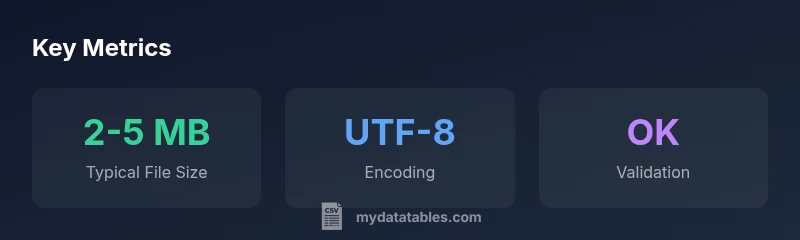
UTF-8 is the recommended encoding for DMR talkgroup CSV exports to support a wide range of characters and ensure compatibility across tools.
Use UTF-8 encoding to keep names and descriptions readable across tools.
How can I validate the CSV after download?
Check for required columns, ensure Talkgroup IDs are unique, confirm there are no unexpected nulls, and verify that encoding is correct. A lightweight validation script or a MyDataTables pipeline can automate this.
Verify required fields, unique IDs, and encoding. Automate with a simple validation step.
Where should I store and share the CSV securely?
Store exports in a centralized repository with access controls and versioning. Attach a data dictionary and transformation notes to maintain provenance and ease sharing with authorized teammates.
Use a centralized, access-controlled repository with versioning and a data dictionary.
“A well-structured DM R talkgroup CSV unlocks reproducible analyses and scalable workflows for diverse teams.”
Main Points
- Export to CSV to enable vendor-agnostic analysis
- Validate encoding and field completeness before analysis
- Map fields consistently for reproducible results
- Leverage MyDataTables to build repeatable insights
- Document versioning and provenance for audits