Download All Mega Millions Winning Numbers as CSV: A Practical Guide
Learn how to download all Mega Millions winning numbers as CSV from official sources, validate data quality, and automate the workflow with MyDataTables guidance for reliable lottery data analysis.


You will learn how to download all mega millions winning numbers as csv and export them for analysis. This quick guide outlines trustworthy sources, data formats, and a reproducible workflow that ensures accuracy, up-to-date results, and easy integration with CSV tools. Follow these steps to create a clean CSV dataset you can reuse in dashboards and models.
Why You Might Want to Download Mega Millions Numbers as CSV
If you’re a data analyst or developer, a CSV export of Mega Millions results makes it easy to run analyses, build dashboards, and test number patterns over time. The process of downloading data and saving it as CSV supports reproducibility, auditability, and portability across tools like Excel, Google Sheets, and Python data pipelines. According to MyDataTables, a well-structured CSV enables reliable joins with other datasets and straightforward time-series analysis. When you specifically aim to
download all mega millions winning numbers as csv you create a portable artifact that can be version-controlled and shared with teammates, consultants, or stakeholders. This initial justification guides the rest of the workflow: source selection, data normalization, encoding, and automated refreshing. By starting with a solid CSV, you minimize rework later and keep your analyses aligned with the latest drawings.
In practice, CSVs support quick filtering, column reordering, and reproducible scripts that transform raw numbers into usable features for forecasting, trend detection, or anomaly monitoring. MyDataTables’ guidance emphasizes source legitimacy, licensing, and clear data schemas so you can trust your historical dataset. This section sets the stage for a safe, scalable approach to obtaining Mega Millions draw data in CSV format.
note2_null_placeholder":null}
Finding and Assessing Data Sources
Reliable Mega Millions data typically originates from official or well-curated portals. Start with the official Mega Millions site, which often provides historical results and downloadable formats. If CSV directly isn’t offered, you can still obtain structured data (HTML or JSON) and convert it into CSV with minimal loss if you follow a consistent schema. Other sources may include state lottery sites and reputable data repositories that describe the data fields and licensing terms. When evaluating sources, prioritize:
- Clear documentation of the data fields (draw date, five numbers, Mega Ball, etc.)
- Versioning or date stamps showing how current the data is
- Licensing that allows reuse in non-commercial or research contexts
As you plan to
download all mega millions winning numbers as csv, prefer sources that explicitly support CSV export or provide machine-readable formats with stable field names. MyDataTables analysis shows that dependable sources enable smoother automated extraction and reduce the risk of inconsistent column orders. Always record the data source and retrieval date for traceability, and note any revisions to historical draws.
note2_null_placeholder":null}
A Reproducible Workflow to Export CSV
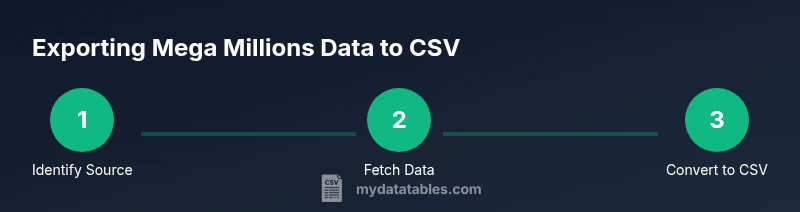
A reproducible workflow starts with identifying the dataset structure and then applying a consistent extraction and conversion method. If the source offers a direct CSV download, your job is straightforward: download, store with a timestamp, and load into your analysis environment. If not, plan to fetch the data in a structured format (HTML tables or JSON) and convert it to CSV using a deterministic schema. The typical pipeline involves:
- Fetching the latest data from a canonical source
- Parsing the data to extract draw date, five white balls, and Mega Ball
- Normalizing date formats and ensuring numeric columns are integers
- Writing the results to a UTF-8 encoded CSV file
- Verifying the CSV structure matches your schema and sample rows look correct
To ensure you can
download all mega millions winning numbers as csv repeatedly, automate the steps with a script or notebook, and store the output in a version-controlled repository. MyDataTables’ approach favors reproducibility, so you can re-run the same steps on any given day to refresh your dataset.
note2_null_placeholder":null}
Quality Checks and Normalization
CSV quality matters for downstream analysis. After you export, perform a quick audit to confirm the columns are correctly named and ordered, and that date values follow a consistent format (e.g., YYYY-MM-DD). Normalize numbers so they’re integers, remove stray spaces, and ensure missing values are handled predictably (e.g., empty strings or sentinel values). Check for duplicates by identifying identical draw dates with identical number sets. If any anomalies appear, flag them for manual review or re-fetch from the source.
Label your dataset clearly with the retrieval date and source, so you can reproduce results later. If you plan to merge this data with other lottery datasets or game variants, align the schema across datasets and confirm encoding is UTF-8 to avoid misread characters. By staying disciplined with normalization, you’ll avoid subtle errors that undermine analyses and forecasting attempts. The end result should be a clean, reusable CSV suitable for dashboards and analytics workflows.
note2_null_placeholder":null}
Automation and Reproducibility for Ongoing Updates
Automating the process ensures you can keep the CSV current without manual effort. Schedule a routine task (cron job, Windows Task Scheduler, or a cloud function) that:
- Pulls the latest Mega Millions draw results from your chosen source
- Converts to CSV if needed and appends new rows to an existing file or creates a new versioned file
- Runs validation checks and logs any discrepancies
- Stores the output in a version-controlled location (e.g., a Git repository or cloud storage with timestamps)
This approach supports ongoing analyses, back-testing, and reproducibility across teams. Documentation should cover the exact steps, dependencies, and any source-specific quirks. If your data source changes field names or formats, update your mapping in a controlled manner and rerun the validation pipeline. The result is a dependable, up-to-date CSV feed you can rely on for inspection and modeling.
note2_null_placeholder":null
Tools & Materials
- Computer with internet access(Used to browse sources and run scripts.)
- CSV editor or spreadsheet software(Excel, Google Sheets, or similar for quick checks.)
- Python with pandas or equivalent(Helpful for parsing HTML/JSON and exporting CSV.)
- Access to Mega Millions data sources(Prefer official or licensed data repositories.)
- Text editor for CSV/JSON(For editing scripts or notes.)
- Command-line tools (curl/wget, jq)(Optional but useful for automation.)
Steps
Estimated time: 60-120 minutes
- 1
Identify trusted data sources
Locate official Mega Millions data or reputable repositories. Confirm licensing and whether CSV export is provided or easily derivable. This ensures you are downloading legitimate data and reduces later licensing concerns.
Tip: Prefer official sources to minimize data drift or license issues. - 2
Fetch or download the dataset
Download the dataset if a direct CSV is available. If not, fetch a structured format (HTML/JSON) from which you will extract the fields you need (date, 5 white balls, Mega Ball).
Tip: Document the source URL and retrieval date for traceability. - 3
Parse and map fields to a consistent schema
Extract draw_date, numbers_1-5, mega_ball, and any extra metadata. Normalize the date to YYYY-MM-DD and ensure numbers are integers. Define a stable CSV header.
Tip: Use a single, documented schema across all imports. - 4
Convert to CSV with UTF-8 encoding
Write the data to a CSV file encoded in UTF-8. Ensure delimiter consistency (comma) and quote handling for any text fields.
Tip: Avoid BOM to prevent parsing issues in some tools. - 5
Validate data integrity and deduplicate
Check for duplicate draws, ensure no missing values in essential columns, and verify numeric ranges fall within expected limits.
Tip: Run a quick script or tool to flag anomalies. - 6
Version and automate the workflow
Store outputs with timestamps and consider scheduling regular refreshes. Create a simple automation plan that can be reused by teammates.
Tip: Document dependencies and steps so others can reproduce.
People Also Ask
What formats are available for Mega Millions data?
Many sources offer CSV or JSON exports; if only HTML is available, you can convert it to CSV with a stable schema. Always check licensing and terms of use.
Most sources provide CSV or JSON; if you see HTML, you can convert it using a structured approach.
Is it legal to download Mega Millions data for analysis?
Data from official lottery sites is generally permitted for personal or research use when licensing terms are followed. Always review the site's terms for any redistribution restrictions.
Usually yes for personal or research use, as long as licensing terms are followed.
How far back do reliable sources go?
Official sources typically provide multiple years of results, but the depth varies by site. Use sources that clearly indicate the date range and include updated draws.
Most sources offer several years of history; check the date range before starting your analysis.
How do I ensure the CSV stays up to date?
Automate data retrieval and CSV export on a schedule, and maintain a versioned archive so you can track updates and reproduce analyses.
Set up an automated refresh so your CSV stays current with minimal manual effort.
Can I merge Mega Millions data with other datasets?
Yes, if you standardize field names and formats across datasets. Use a common date format and consistent numeric fields for reliable joins.
Yes, with consistent formatting and a shared schema, merges work smoothly.
What are common pitfalls when exporting lottery data?
Inconsistent headers, non-UTF-8 encoding, missing values, and not handling duplicates can all derail analyses. Validate carefully before using the CSV.
Watch for encoding, header consistency, and duplicates to avoid errors.
Watch Video
Main Points
- Plan with trusted sources and a clear schema
- Export or convert to UTF-8 CSV for compatibility
- Automate refreshing to maintain up-to-date data
- Validate and version data to ensure reproducibility