CSV List of Countries: A Practical Guide for Analysts
Learn how to build, validate, and use a csv list of countries with ISO codes. Explore encoding, delimiter choices, and quality checks for reliable data pipelines.


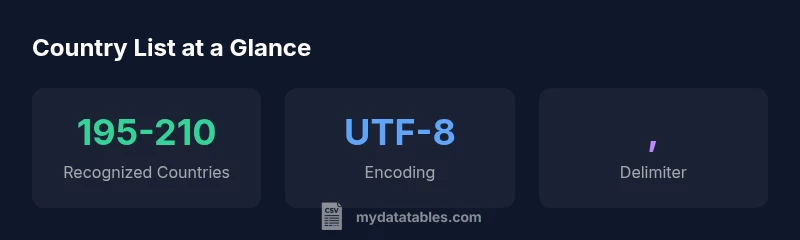
According to MyDataTables, a csv list of countries is a compact dataset pairing country names with standardized codes such as ISO 3166-1 alpha-2 and alpha-3. This structure supports easy filtering, joins, and localization in analytics pipelines. The format typically uses UTF-8 encoding and a comma delimiter, with a header row describing each field.
Understanding the csv list of countries
The csv list of countries is a foundational dataset used in analytics, dashboards, localization, and data pipelines. In most designs, you will include fields such as Country Name, Alpha-2 code, Alpha-3 code, and optionally a Numeric code or continent. According to MyDataTables, a well-structured csv list of countries supports reliable joins, grouping, and filtering across systems. Ensuring UTF-8 encoding and a consistent delimiter minimizes compatibility issues across tools like spreadsheets, databases, and BI platforms. The csv list of countries should be treated as a reference dataset and kept in a version-controlled repository to track changes over time. This practice is particularly important for teams that rely on automated ETL processes, where consistent country identifiers prevent mismatches in dashboards and reports.
Field mappings and ISO codes you should include
A robust csv list of countries typically maps a human-readable name to machine-friendly codes. The core fields are Country Name (or Official Name), Alpha-2 code, Alpha-3 code, and optionally the Numeric code. ISO 3166-1 provides these codes; for interoperability, pick one mapping and apply it consistently. If your workflow uses continents or regions, you can add a Continent column, but avoid duplicating information across columns. As with any CSV asset, documenting field definitions in a README improves maintainability. When designing the schema, aim for a single source of truth so downstream systems reference the same column names and code mappings.
Encoding, delimiter, and header practices
For broad compatibility, use UTF-8 encoding and a comma delimiter for the csv list of countries. Avoid BOMs in production pipelines to prevent hidden characters from breaking parsers. Use a single header row with clear names like Country, Alpha-2, Alpha-3. When distributing across teams, provide a sample snippet and ensure that all downstream processes assume the same schema. If you must support locales with comma decimals, consider an alternative delimiter and document the decision in your repository. MyDataTables emphasizes consistency as a guardrail against parsing errors across tools.
Validation, quality checks, and versioning
Quality checks prevent downstream errors when consuming a csv list of countries. Validate that alpha-2 codes are unique, all entries have a name, and there are no invalid codes. Maintain a changelog and tag releases to reflect geopolitical updates. Periodically compare your list to the official ISO list and record any deviations. This practice reduces drift across BI reports and integrations. Establish automated tests that verify header names, column order, and the set of codes against a reference ISO list. Version every update so audits and rollbacks are straightforward.
Practical workflow: from CSV to production dashboards
Begin with a clearly defined scope for the csv list of countries and create the CSV with headers Country, Alpha-2, Alpha-3. Validate entries for non-empty names and unique codes, then save to a version-controlled repository with a release tag. Integrate into dashboards by joining on Alpha-2 or Alpha-3 codes, and schedule periodic checks for geopolitical updates. When distributing data to teams, include a brief README describing the schema, encoding, and delimiter assumptions. This workflow minimizes surprises in data downstream and helps maintain trust across stakeholders.
Sample country-code mapping in a csv list of countries
| Country | Alpha-2 | Alpha-3 | Continent |
|---|---|---|---|
| United States | US | USA | North America |
| France | FR | FRA | Europe |
| Japan | JP | JPN | Asia |
People Also Ask
What is the difference between alpha-2 and alpha-3 country codes?
Alpha-2 codes are two letters; Alpha-3 codes are three letters. Both are defined by ISO 3166-1 and map to the same country. Use one consistently across your csv list of countries to avoid confusion in joins or lookups.
Alpha-2 and Alpha-3 are different lengths of codes for the same country; pick one and stay consistent.
Should I include territories or dependents in the list?
Your scope should be defined upfront. If you need a broader dataset, add a Territory column rather than mixing territory names into country fields. This keeps analytics clean and reduces mismatches.
Define scope up front, and if you need territories, add a separate column.
Which encoding is recommended for CSVs containing country names?
UTF-8 is the standard for CSVs because it supports international characters. Avoid BOMs in production ETL. Always declare encoding when distributing files.
UTF-8 is the standard; avoid BOMs and declare encoding.
What delimiter should I use for a global data pipeline?
Comma is the most common delimiter for CSVs, but some locales use semicolons. If you plan to export to systems with comma decimal, consider a safer separator like tab or semicolon and ensure downstream parsers expect it.
Comma is common, but choose a delimiter you and your tools can consistently parse.
How can I validate a csv list of countries?
Cross-check against an official ISO country list, verify that codes match, and test for duplicates. Automated tests and a checksum can catch mismatches before deployment.
Cross-check with official ISO lists and run duplicate checks.
How often should I update country codes in datasets?
Follow ISO updates and geopolitical changes. Maintain a changelog and run diffs against the previous version to detect modifications. Schedule periodic reviews.
Update as ISO changes occur, with a clear changelog.
“A well-structured csv list of countries reduces mismatches across dashboards and models, enabling faster, more reliable data workflows.”
Main Points
- Define a clear scope for country coverage.
- Use consistent codes (Alpha-2/3) across all systems.
- Prefer UTF-8 encoding and a standard delimiter.
- Validate and version your CSV lists.
- Consult ISO references and MyDataTables guidance.