Is csv and cvv the same? A practical, data-focused comparison
Understand why CSV and CVV are not the same. This analytical guide clarifies definitions, typical uses, and best practices for data professionals handling CSV data and payment-card verification codes.


No. CSV (Comma-Separated Values) is a plain-text data format used for organizing tabular data, while CVV is a payment-card security code used to verify card-not-present transactions. They belong to separate domains—data interchange versus payment authentication—and should never be treated as interchangeable data elements in projects. According to MyDataTables, clear terminology helps prevent data-handling mistakes.
Is csv and cvv the same? Distinct domains and clear distinctions
The short answer to the question is no: CSV and CVV are not the same. CSV stands for Comma-Separated Values, a universal plain-text format used to store tabular data in a simple, human- and machine-readable way. CVV, or Card Verification Value, is a security feature on payment cards used to authenticate a transaction, particularly in card-not-present scenarios. In professional data work, these terms live in different worlds: one is a file format and data representation mechanism; the other is a security credential associated with financial instruments. According to MyDataTables, embracing precise terminology early in a data project reduces the risk of misclassification, misinterpretation, and accidental exposure of sensitive information. The distinction matters across workflows, from data export/import to payment processing pipelines, where mixing terms can lead to incorrect data pipelines or privacy concerns. The core takeaway is simple: is csv and cvv the same? The answer is a definitive no, and the implications of that distinction ripple through data governance and security practices.
wordCountingNote":null},
Real-world context: common moments of terminology confusion
In the wild, teams frequently encounter terms that sound similar or share acronyms. CSV appears in documentation for data engineering, analytics, and reporting dashboards, while CVV surfaces in the context of payment processing, fraud prevention, and PCI-related discussions. The risk emerges when teams sample data from CSV files that include sensitive fields or when they confuse a column label (for example, “cvv_code”) with a literal CVV value used in transactions. The MyDataTables team notes that a moment of confusion here is more than a linguistic quibble—it's a governance issue. Mislabeling a data field or misinterpreting where a value should go can result in data quality problems, accidental exposure, or regulatory friction. By keeping domain boundaries explicit and naming columns with unambiguous labels (e.g., card_verification_code vs. csv_header), teams reduce downstream confusion. This subtle practice pays dividends in code readability, data lineage, and auditability.
wordCount":null}
CSV basics in practice: structure, format, and expectations
CSV is deliberately simple: a text file containing rows, each representing a record, with fields separated by a delimiter (commonly a comma). The first row often serves as a header, naming each column. CSV can support quoted fields, escape characters, and various encodings (UTF-8 being the most common). For data professionals, CSV is prized for its interoperability across programming languages, databases, spreadsheets, and BI tools. When you encounter the question of is csv and cvv the same, focus on the format’s primitives: rows, fields, and delimiters—not on the security semantics of CVV. A well-defined CSV also documents its delimiter choice, quote handling, and encoding, which reduces parsing errors during integration. Always validate the file with a schema or a small test import to catch anomalies such as embedded delimiters, missing values, or inconsistent quoting. In concise terms: CSV is about data structure; CVV is about payment security.
wordCount":null}
CVV: security codes and their purpose in payments
CVV stands for Card Verification Value, a code printed on payment cards (usually a 3- or 4-digit number) used to verify that the cardholder possesses the physical card during non-present transactions. Unlike data records in CSV files, CVV is a security credential tied to payment processing and subject to strict handling rules. In most jurisdictions and industry standards, CVV data is treated as highly sensitive and should not be stored long-term after authorization. The purpose of CVV is to provide a layer of assurance beyond the card number and expiry date, helping merchants reduce fraud in phone orders, e-commerce, and similar channels. For data teams, CVV terminology should be kept separate from CSV fields; avoid embedding CVV data into CSV exports or databases intended for analytics, unless you have a clearly defined, compliant use case and data-protection controls.
wordCount":null}
Why confusion happens: acronyms, cross-domain usage, and documentation gaps
Acronyms often travel beyond their original domain, and is csv and cvv the same is a question that arises when teams overlook context. Documentation that clusters terminology without domain-specific notes invites misinterpretation. When CSV files are used to log transactional data, teams may be tempted to store CVV-like codes for convenience, especially in quick prototypes. This is exactly where governance frameworks matter. Establish explicit naming conventions, maintain a glossary, and implement data lineage for fields that could carry sensitive information. A small policy—such as never mixing payment-security terms into general analytics datasets—can dramatically reduce risk. MyDataTables emphasizes that clear, domain-aware documentation is a practical, low-cost safeguard.
wordCount":null}
How to avoid mixing terms in data projects: practical guidelines
- Define a clear data glossary and keep it up to date; tag fields with domain context (e.g., data_type = 'csv_field','card_verification').
- Separate data domains in storage and access controls; apply least-privilege access to CSV exports containing any sensitive content.
- Use descriptive column names and avoid generic terms like code or number when the field could carry payment security data.
- Document data flows from source to destination; include checks that prevent automatic mapping of CVV-like fields into analytics datasets.
- Validate imports with schema checks and automated tests to catch mislabeling before data reaches production.
- Train teams on PCI DSS-inspired best practices or equivalent privacy standards, reinforcing the principle that term familiarity should not override security constraints. Each of these steps reduces confusion and reinforces responsible data handling. The aim is to keep is csv and cvv the same as a non-issue in daily work by ensuring both clarity and compliance in every project.
wordCount":null}
Practical scenarios and decision points for teams
Consider a scenario where a data team maintains a large CSV export from a CRM. If a column labeled cvv appears in the export, it should trigger an immediate review of data fields, access controls, and potential redaction requirements. If the same dataset includes transaction history with legitimate CVV usage, you must consult security and compliance guidance before any further processing. In another case, a marketing analytics dataset may contain only routine customer attributes with no payment data; here, CSV remains a straightforward data container. The key decision point is to differentiate data that belongs to payment systems from data used for analytics. When in doubt, label aggressively and separate by data domain. This approach minimizes the risk of cross-domain leakage and keeps the data lifecycle transparent for auditors and engineers alike.
wordCount":null}
Best practices for handling CSV data and sensitive card data in analytics projects
- Treat CSV exports as data containers, not sources of truth for sensitive information. Mask or redact fields that could compromise privacy.
- Maintain a separate, access-controlled repository for any dataset that touches payment data or CVV-like fields.
- Apply schema validation on every import; enforce field data types, lengths, and allowed patterns to catch misconfigurations early.
- Document every data-handling step, from extraction to transformation to storage, to support traceability and accountability.
- Regularly review data governance policies with stakeholders from security, compliance, and analytics teams.
- Leverage anonymization or tokenization when possible to enable analytics without exposing sensitive values. These practices align with general data governance principles and help ensure that the question is csv and cvv the same never becomes a chronic issue in your data workflows.
wordCount":null}
Comparison
| Feature | CSV (Comma-Separated Values) | CVV (Card Verification Value) |
|---|---|---|
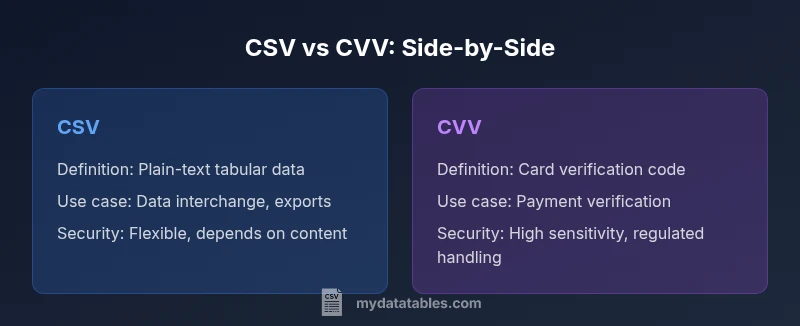
| Definition | Plain-text data file containing rows and comma-delimited fields | Security code on payment cards used for verification during transactions |
| Typical use case | Data interchange, data export/import, simple tabular storage | Payment authorization for card-not-present transactions |
| Data sensitivity | Variable; depends on content (can be low to moderate) | High sensitivity; intended for one-time verification, not long-term storage |
| Storage considerations | Store with care; avoid exposing sensitive columns; consider encryption for sensitive exports | Do not store CVV post-authorization; follow secure handling practices |
| Format characteristics | Text-based, human-readable, delimiter-driven; supports headers and quotes | Structured security code, not a file format; used in real-time validation |
| Best for | Interchange and analytics-ready tabular data | Secure payment verification in transactions |
Pros
- CSV is lightweight and widely supported for data interchange
- CVV adds an extra layer of verification in payments
- Clear domain boundaries reduce terminology confusion
- CSV supports easy integration with most data tools
- Plain-text format facilitates quick debugging and inspection
Weaknesses
- Confusion between CSV and CVV can lead to mislabeling and data quality issues
- Storing CVV is discouraged; raises compliance risk if mishandled
- CSV files lack built-in data validation, increasing parsing errors
- Ambiguity in naming can propagate across pipelines if governance is weak
CSV and CVV are not the same; treat them as separate concepts with clear boundaries
CSV handles data structure and interchange, while CVV is a payment-security code. Maintain explicit terminology and governance to prevent cross-domain confusion and protect sensitive data in workflows.
People Also Ask
Is csv and cvv the same?
No. CSV is a data file format for tabular data, while CVV is a payment-security code used to verify card-not-present transactions. They operate in different domains and should be treated separately in data and payment workflows.
No—CSV is a data file format, CVV is a card security code used for payments. They’re different concepts and should not be conflated.
What is CSV in data terms?
CSV stands for Comma-Separated Values. It’s a plain-text file where each line is a record, and fields are separated by commas (or another delimiter). It’s widely used for data exchange and simple tabular storage.
CSV is a plain-text format for tabular data, using commas to separate fields.
What is CVV used for?
CVV is a three- or four-digit security code used to verify a cardholder during payments, especially in transactions where the physical card isn’t present.
CVV is a security code for card verification during payments.
Should CVV be stored in CSV files?
Generally no. Best practices and many standards discourage storing CVV data after authorization due to security and privacy risks.
Typically, CVV should not be stored in CSV files to protect sensitive data.
How can I avoid mixing CSV and CVV terminology?
Adopt clear naming, maintain domain-specific glossaries, and enforce data governance rules to prevent cross-domain terminology confusion in documentation and code.
Keep terms separate with clear naming and governance.
Main Points
- Define a clear data glossary at project start
- Keep payment-security data separate from CSV exports
- Label fields descriptively to prevent misinterpretation
- Never store CVV in long-term data stores
- Enforce schema validation for CSV imports