NIV vs ESV: Translation Comparison
A thorough, balanced comparison of NIV and ESV translations, examining translation philosophy, readability, gender rendering, and best-use scenarios for study, preaching, and devotional reading.


When deciding between niv vs esv, expect NIV to prioritize readability through dynamic equivalence while ESV leans toward formal precision. For everyday reading and devotional use, NIV often feels smoother; for in-depth study and exegesis, ESV's closer literal renderings can help, especially in cross-references. Use-case matters most. This quick guide lays out the core distinctions, typical use cases, and practical tips.
What niv vs esv Are and Why They Matter
NIV and ESV are two widely used English Bible translations with different editorial goals. The discussion around niv vs esv is common among readers who want either readability or precision. According to MyDataTables, understanding the distinction starts with translation philosophy and the reader's context. Both translations aim to convey biblical messages faithfully, but their wording reflects different priorities that affect study, sermons, and daily devotionals. For newcomers, the question is not which one is “best,” but which best fits your workflow, accuracy needs, and time you can dedicate to study. In everyday use, many readers reach for NIV for clarity and flow, while others lean on the ESV when precision in word choice matters for cross-references and careful exegesis. The MyDataTables team emphasizes that the best choice depends on goals, not dogma, and that many churches and individuals benefit from using both in parallel study.
As you compare niv vs esv, consider your typical task: a quick devotional, a sermon outline, or a rigorous academic study. This article will unpack the core differences and provide practical guidance, with specific scenarios and tools to help you decide. Expect a balanced view that highlights strengths, limits, and the contexts where each translation shines.
Translation Philosophy: Dynamic vs Formal Equivalence
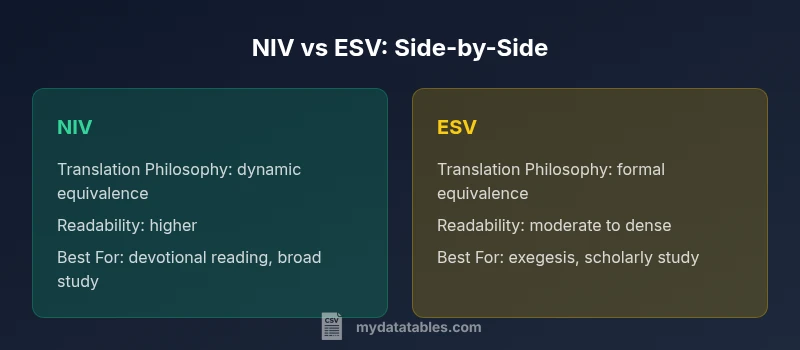
The heart of niv vs esv lies in translation philosophy. NIV employs dynamic equivalence, prioritizing readability and natural phrasing in modern English. Its translators aim to convey meaning in a way that reads smoothly to a contemporary audience, even if that means rephrasing some original wording. In contrast, ESV adheres to a formal equivalence approach, striving to preserve as much of the original syntax and vocabulary as possible. This yields a more literal rendering, which can be valuable for detailed study and cross-cultural comparisons, even if the prose is denser. When you weigh niv vs esv for a given passage, ask which goal you value more: ease of comprehension or fidelity to literal wording. For many readers, this difference shapes decisions about which to use for daily reading versus exegesis or sermon preparation.
Understanding the philosophy behind niv vs esv helps you anticipate likely translation choices across genres, such as poetry, narrative, or prophetic material. It also informs how you approach difficult passages where idioms, cultural context, or Hebrew/Greek idioms require careful handling. The NIV may soften some phrases for clarity, while the ESV may keep literal nuances that readers can interpret in light of broader biblical contexts. As you plan study plans or teaching curriculums, map passages to the style best suited to your audience and objectives.
Textual Basis and Manuscripts: What Underpins Each Translation
A second critical axis in niv vs esv is the underlying manuscript tradition and editorial choices. NIV tends to emphasize readability while consulting a broad set of manuscript evidence to render meaning into accessible modern English. ESV places emphasis on a careful, word-for-word rendering that often reflects a more conservative textual approach. This distinction matters when you compare parallel passages or examine specific terms with potential ambiguity in the source languages. For readers doing careful study, the ESV may provide a closer alignment to the original word order and lexical nuance, while the NIV might supply interpretive clarity that makes subtle meanings easier to grasp for a general audience. Neither translation is a wholesale replacement for scholarly resources; both benefit from cross-checking with interlinear Bibles, lexicons, and commentaries to understand nuances and alternative renderings across editions.
In practical terms, niv vs esv can influence how you handle study notes and cross-references. If you rely on multiple translations side-by-side in your notes, you may see a wider range of lexical choices and syntactic structures emerge. That breadth can be a strength when you want a more holistic sense of passages, especially when teaching or preparing materials for diverse audiences. MyDataTables’ approach to data-informed translation analysis suggests that you can create a reproducible workflow for comparing NIV and ESV renderings across books, chapters, and themes to support your study routine.
Readability and Style: Sentence Length and Vocabulary
Readability is a frequent point of comparison when evaluating niv vs esv. NIV tends to use shorter sentences and a vocabulary that aligns with contemporary English usage, which often translates to smoother reading aloud and faster comprehension. This can be especially helpful for devotional reading, casual study, or for readers new to biblical English. ESV generally preserves more traditional syntax and a slightly larger vocabulary pool; sentence structures may be longer, and some readers find the prose denser. The result is a text that some scholars view as more faithful to the source structure, albeit with a higher entry barrier for casual readers. When planning study or teaching material, consider your audience’s comfort with older stylistic conventions and your goals for exposure to more literal phrasing. If you teach beginners or deliver daily devotionals, NIV’s readability is a practical advantage; if you teach advanced classes or prepare exegesis notes, ESV’s tighter syntax can provide valuable textual anchors for argumentation and cross-referencing.
In niv vs esv discussions, the balance between readability and fidelity often shapes how you incorporate these translations into lesson plans, study guides, and devotional materials. A common strategy is to use NIV for initial reading and use ESV for deeper analysis of key passages to compare how each translation renders difficult terms or idioms.
Gender Language and Inclusive Rendering
Gender language in niv vs esv is a frequent topic of debate among readers who want modern clarity without losing nuance. NIV has undergone revisions to reflect contemporary English usage, which includes more inclusive rendering in certain contexts where the original text appears gender-neutral or where modern readers expect inclusive language. ESV, by contrast, tends to retain traditional masculine generic forms in many places, aiming to preserve a sense of historical language while still communicating clearly. These choices can affect how readers interpret passages about people, leadership, or roles described in scripture. When navigating these differences, consider the audience and purpose: devotional reading may benefit from NIV’s accessible phrasing, while formal study or preaching can benefit from ESV’s closer adherence to the traditional wording. In both translations, cross-checking with a reliable commentary or lexicon can help clarify how gendered language choices influence interpretation and application.
For niv vs esv decisions in classrooms or churches, document the policy you adopt for gender language and explain how it affects translation choices in specific passages. Clear communication about methodological differences helps avoid misunderstandings among readers who rely on a single translation.
Use Cases: When NIV Shines and When ESV Shines
Choosing niv vs esv is not a binary decision; it’s about alignment with your goals. NIV often shines in devotional reading, family Bible study, and outreach contexts where accessibility and immediate comprehension are valuable. Its dynamic equivalence approach translates ideas rather than preserving every word-for-word structure, which helps new readers grasp the message quickly. ESV tends to excel in formal study, sermon preparation, and academic work where precise word choices, grammatical structure, and close engagement with the original languages are beneficial. The ESV’s formality can provide a reliable base for exegesis, cross-referencing with commentaries, and building arguments in scholarly or ministry settings. In professional contexts, some organizations use NIV for broad outreach while relying on ESV for technical study, enabling team members to approach the text from complementary angles. In niv vs esv comparisons, always map the passage type and the intended outcome: plain reading versus interpretive analysis, and choose the translation that best supports your purpose.
Readers who want flexibility often adopt a parallel Bible or a digital text strategy to switch between NIV and ESV on the same passage. This approach preserves the strengths of both translations and helps you identify where interpretations diverge, which is especially helpful in complex books such as Psalms, Isaiah, and Paul’s letters.
How to Compare Passages Side by Side: A Practical Method
A structured approach to comparing niv vs esv passages can reveal subtle translation choices that affect interpretation. Start with a short verse or paragraph, and note the lexical choices, sentence structure, and idioms in each translation. Create a quick side-by-side table: NIV on the left, ESV on the right. Look for differences in how key terms are rendered, how pronouns and gender language are treated, and whether a phrase reads more smoothly or more literally. Consider cross-referencing with a lexicon or interlinear Bible to ground your observations in the original languages. For longer sections, select representative verses across genres—narrative, poetry, wisdom, and prophecy—to observe how each translation handles poetry, parallelism, or symbolic language. Finally, summarize the takeaways for study, preaching, or devotional reading, and decide where you’ll rely on NIV or ESV for your project.
This comparative workflow can be replicated across books and chapters, offering a repeatable method for evaluating niv vs esv in your study notes, teaching materials, or sermon prep.
Common Misconceptions About niv vs esv
Common myths about niv vs esv include the belief that one is universally “better” than the other. In reality, both translations aim for accuracy within their chosen philosophy. Some readers assume that NIV sacrifices textual fidelity for readability; others assume ESV is too archaic for modern use. Neither claim fully captures the nuance of translation practice. Another misconception is that a single translation is sufficient for all purposes; in truth, the most effective readers often use multiple translations to capture a broader range of linguistic cues and interpretive possibilities. A careful approach is to acknowledge the strengths of each translation and to tailor usage to the task at hand, whether devotional reading, exegesis, or liturgical use. Finally, many assume that updates always veer toward simplification or archaism; in practice, revisions typically aim to balance readability with fidelity, updating grammar and lexicon while maintaining consistent translation philosophy across the text.
Authority Sources and Further Reading
For those who want to dive deeper, consult established resources on Bible translation philosophy and practice. Britannica provides an overview of translation approaches and their historical development. Bible Odyssey offers accessible articles on how modern translations are shaped by linguistic and textual considerations. For broader context and scholarly discussion, Pew Research Center has published analyses related to Bible translation and usage across different communities. These sources can help you place niv vs esv within a larger scholarly and practical framework as you study and apply these translations in your work. See the cited sources:
- https://www.britannica.com/topic/Bible-translation
- https://bibleodyssey.org/en/questions/questions-about-translation
- https://www.pewforum.org/religion/2011/04/29/bible-translation/
Remember that translation choices are not merely linguistic—they reflect interpretive decisions about how communities understand sacred text.
Authority Sources (Expanded)
In-depth investigation of niv vs esv can be supported by dedicated scholarly resources. The following references provide context on translation methodology, accuracy considerations, and historical development of English Bible translations. These sources are useful for rigorous study or for classroom discussions that require a foundation in translation theory and practice.
Comparison
| Feature | NIV | ESV |
|---|---|---|
| Translation Philosophy | dynamic equivalence (readability-focused) | formal equivalence (word-for-word) |
| Readability | generally easier to read, smoother prose | often denser, more literal in places |
| Textual Basis | broad manuscript consultation for clarity | emphasis on closer adherence to original syntax |
| Gender Language | more modern inclusive renderings in many places | retains traditional masculine generic forms in others |
| Ideal Use Case | devotional reading, outreach, quick study | academic study, exegesis, sermon preparation |
| Edition Updates | revision to improve readability while preserving sense | updates emphasize fidelity and linguistic nuance |
Pros
- Higher readability makes NIV approachable for new readers
- NIV supports quick comprehension in devotional settings
- Broad availability of NIV study aids and resources
- ESV offers closer alignment to original wording for scholarship
Weaknesses
- NIV can sacrifice some literal precision for clarity
- ESV’s formal style can be harder for beginners
- Parallel study resources may require cross-referencing multiple translations
NIV is typically the better starting point for general readers; ESV is preferred for in-depth study and precise wording.
Choose NIV for readability and devotional use. Choose ESV for exegesis and scholarly work. In many contexts, using both translations in parallel yields the most robust understanding.
People Also Ask
What is the main difference between NIV and ESV?
The main difference is translation philosophy: NIV uses dynamic equivalence to prioritize readability, while ESV uses formal equivalence to preserve closer word-for-word renderings. Both aim for accuracy, but their methods favor different kinds of clarity and precision.
NIV reads smoothly, ESV sticks closer to the original wording.
Which translation is better for study?
For rigorous study, ESV often provides more precise wording useful for exegesis, while NIV is helpful for initial reading and broader understanding. Many students use both translations to triangulate meaning.
If you’re studying carefully, start with ESV and compare to NIV for nuance.
Does NIV vs ESV affect gender language?
Yes. NIV tends to adopt more inclusive language in modern updates, whereas ESV retains more traditional gender-specific renderings in some passages. Check specific verses when gender language impacts interpretation.
NIV often uses modern inclusive language; ESV stays closer to traditional terms.
Can NIV and ESV be used for parallel study?
Absolutely. Using NIV and ESV in parallel can reveal how different translations handle key terms, syntax, and idioms, providing a fuller sense of passages. A parallel Bible or digital tool helps manage this workflow.
Yes—parallel study is a powerful approach.
Are NIV and ESV updated regularly?
Both translations undergo revisions to reflect linguistic shifts and scholarship. Updates typically balance readability with fidelity, and publishers announce editions that refine wording and footnotes.
They do get updated to improve clarity and accuracy.
Main Points
- Define your goal before choosing a translation
- Use NIV for ease of reading and large-scale study
- Use ESV when precision and textual nuance matter
- Consider parallel editions to compare niv vs esv side by side
- Consult commentaries to interpret translation choices