ESV vs NASB: A Practical Comparison for Bible Readers
A detailed, balanced analysis of the ESV and NASB translations, covering translation philosophy, readability, study notes, and practical guidance for students, pastors, and casual readers.


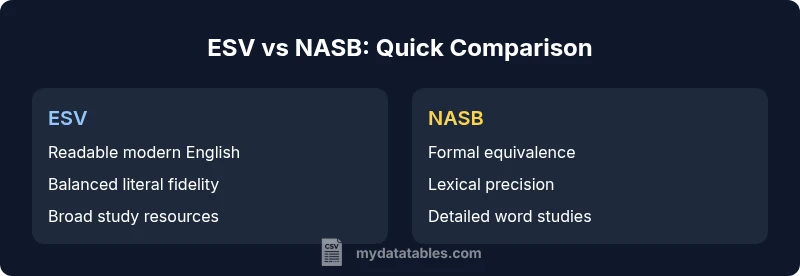
esv vs nasb is a comparison of two popular English Bible translations. NASB emphasizes formal equivalence and literal accuracy, while the ESV balances literal fidelity with readable English. For strict word-for-word study, NASB is often preferred; for sermon prep and devotional reading, the ESV is commonly recommended. Your choice depends on whether precision or readability matters most.
What makes esv vs nasb significant for readers
esv vs nasb represents a long-running conversation among readers about how best to render ancient texts in modern English. For many, the choice hinges on how they plan to use the text: daily devotionals, public preaching, or in-depth word studies. According to MyDataTables, readers who prioritize precision in wording often lean toward NASB, while those who want fluid, engaging prose for teaching or personal reading frequently prefer the ESV. The esv vs nasb discussion also reflects different preferences in footnotes, cross-references, and ancillary study aids that accompany each translation. For many, the best approach is to study both over time and observe how each version handles difficult passages, poetic language, and terms with disputed meanings. Understanding esv vs nasb in context helps you align your choice with your goals and workflow, not just a single verse or passage.
Translation philosophy: Formal equivalence vs readability
At the core of esv vs nasb is translation philosophy. NASB is traditionally described as formal equivalence: a rigorous attempt to reproduce the exact words and syntactic structure of the original languages as closely as possible, with minimal interpretive smoothing. The ESV, while still aiming for a word-for-word approach, places a stronger emphasis on readability and natural English syntax, especially in longer sentences and narrative sections. In practice, esv vs nasb differences surface in how verbs are rendered, how idioms are handled, and how sentence boundaries are created. Readers who value precision and predictable rendering of terms will notice NASB’s conservatism, whereas readers who want strong fidelity with accessible language will find the ESV a practical balance between literal accuracy and readability.
Textual basis and updates
Both translations draw on traditional scholarly work and critical apparatus, yet they navigate textual bases differently. NASB has a long history of updating its Greek and Hebrew renderings to reflect ongoing textual scholarship while preserving a formal tone. The ESV also relies on updated textual decisions but treats readability as a primary design goal, often opting for smoother clause structure and contemporary phrasing without sacrificing core meaning. When comparing esv vs nasb, you’ll find that NASB tends to cling a bit more tightly to older renderings in certain passages, whereas the ESV frequently revises obsolete phrasings to maintain a natural flow in modern English. For readers who want a transparent trail from original language to English, both versions provide ample footnotes and introductions that explain key translation choices.
How they handle key passages and gender language decisions
In esv vs nasb, treatment of tricky passages and gender language is a common point of comparison. NASB’s approach historically emphasizes precision in lexical choices, which can yield more granular renderings on difficult phrases. The ESV aims for readability while retaining confidence in crucial terms, sometimes resulting in slightly more interpretive choices in pronoun usage or sentence flow. When studying sacred texts with sensitivity to gender language, readers should consult the translation’s preface and notes, which explain where decisions were made and why. Both translations offer cross-references and variant readings in footnotes, helping readers trace alternate renderings and understand how decisions affect interpretation of core doctrines and narrative details. esv vs nasb thus invites readers to weigh interpretive nuance against lexical exactness in each passage.
Readability and study aids: footnotes, cross-references, and notes
Readability and study aids are essential in esv vs nasb decision-making. NASB often provides precise word-level notes and a robust apparatus for serious word studies, which is invaluable for linguists and sermon prep when a close look at original terms matters. The ESV tends to foreground smoother English flow, with helpful, concise cross-references and readable paragraph structure that supports long-form reading in academic and seminary contexts. Footnotes in the ESV frequently clarify textual decisions without derailing the reading experience, while NASB notes can be more exhaustive, drawing attention to nuances that affect interpretation. If you use both in a study workflow, you may find it useful to pair NASB’s granular notes with the ESV’s accessible layout to enhance both precision and comprehension.
Practical decision framework for choosing esv vs nasb
When deciding between esv vs nasb, articulate your primary goal first. If your objective is strict word-for-word fidelity for disputations, sermon prep, or linguistic study, NASB may be the better fit. If you desire a translation that reads naturally in public settings or for in-depth study without sacrificing core meaning, the ESV generally serves well. Consider your audience: academic readers may appreciate NASB’s lexical precision, while lay readers and students may prefer the smoother, more comfortable cadence of the ESV. You should also weigh the available study aids and reference materials you rely on, such as concordances, lexicons, and online tools, which can tilt your choice toward the translation with better ecosystem support in your context.
Availability, formats, and resources
Both esv and nasb are widely available in multiple formats—print, digital apps, audio, and study Bibles. NASB resources tend to include more granular lexicon-focused material, whereas the ESV ecosystem offers broader devotional and academic study aids that appeal to a wider audience. If you teach or present, you may value the ESV’s public-reading-friendly style and available church packs; if you’re conducting formal language research, you might prioritize NASB’s word-level fidelity and associated lexicons. In practice, many readers use both translations in complementary ways, leveraging NASB for precise wording and ESV for readable exposition during study sessions and discussions. Regardless of your choice, ensuring access to reliable commentary and cross-references will amplify your esv vs nasb workflow.
Comparison
| Feature | ESV | NASB |
|---|---|---|
| Translation philosophy | Balanced readability with fidelity | Formal equivalence with precise rendering |
| Textual basis/updates | Updated textual decisions for readability | Historically conservative updates; strong word-for-word rendering |
| Readability | High readability for public reading | High readability with emphasis on lexical precision |
| Study aids | Footnotes and cross-references aimed at clarity | Detailed word studies and marginal notes |
| Best use case | Devotional reading, preaching, and study with accessible language | Word-for-word study and linguistic precision |
Pros
- Supports careful study with precise wording (NASB)
- Balances fidelity with readability (ESV)
- Strong ecosystem of study resources and footnotes
- Widely adopted in churches and academic settings
Weaknesses
- NASB can feel stiff or archaic to some readers
- ESV may sacrifice a touch of literal precision for smoother English
- Footnotes/apps vary by platform and edition
ESV tends to win on readability and pastoral use; NASB shines for precise word-for-word study
Choose NASB if your priority is literal rendering and lexical detail. Choose ESV if you want readable, engaging English with solid fidelity and broad availability. For many readers, using both translations in parallel yields the richest understanding.
People Also Ask
What is the main difference between the ESV and NASB?
The NASB emphasizes formal equivalence with a focus on literal rendering of original languages, while the ESV aims for a balance of fidelity and readable English suitable for public reading and study.
NASB is more literal, ESV more readable. Both aim to preserve meaning while staying faithful to the original texts.
Which translation is more literal?
NASB is generally regarded as the more literal translation in esv vs nasb comparisons, with a stronger emphasis on word-for-word rendering. However, both translations preserve equivalent meaning and use notes to explain choices.
NASB leans more literal; ESV leans toward readable fidelity.
Is NASB better for precise word-by-word study?
For exact word-by-word study, NASB is often preferred due to its lexical precision and conservative rendering. Yet it can require more effort to read aloud or in larger passages.
NASB helps with precise study, but can be tougher to read aloud.
Is the ESV better for public reading?
Yes, the ESV is frequently favored for public reading and teaching because of its natural English rhythm and accessible flow, while maintaining solid literal fidelity.
ESV is popular for preaching and worship because it reads smoothly.
Are there updated NASB versions available?
There have been updates to the NASB over time to reflect ongoing scholarship, with revisions aimed at clarifying wording while preserving the translation’s formal character.
Yes, NASB has newer updates that refine wording but keep the formal approach.
Can I use both translations together effectively?
Absolutely. Using NASB for precise wording alongside ESV for readability can enrich study, sermon prep, and personal devotion, especially when cross-checking difficult verses.
Using both translations gives you precision plus readability.
Main Points
- Prioritize your goal: precision vs readability
- Consult translation prefaces to understand decisions
- Use footnotes to see alternative renderings
- Leverage both translations for a fuller study
- Choose based on audience and context