NLT vs ESV: A Practical Translation Comparison
A thorough, analytical comparison of the New Living Translation (NLT) and the English Standard Version (ESV) to help readers decide which Bible translation fits study, devotion, or teaching in 2026.


On the question of nlt vs esv, the quick takeaway is simple: if you want clear, natural English for daily reading, the NLT is often preferable; if you need closer alignment to the original languages for study or sermon prep, the ESV is typically the better choice. Many readers use both, depending on context, even in 2026.
NLT vs ESV: Translation Philosophy and Historical Context
Among popular Bible translations, two names often surface in classrooms and study groups: the New Living Translation (NLT) and the English Standard Version (ESV). The phrase "nlt vs esv" captures a practical choice many readers face when starting a study plan. Understanding the core philosophy of each translation helps determine which to rely on for devotional reading, sermon preparation, or scholarly work. The NLT emphasizes readability and contemporary language, aiming to convey meaning in a way a modern reader can grasp without constantly cross-referencing original languages. The ESV consciously leans toward formal equivalence, striving to remain faithful to word order and textual structure, so readers can examine original wording with less paraphrase. Both translations have undergone extensive revision processes and rely on robust manuscript bases. For a new user, the decision often boils down to whether you want to prioritize ease of reading (NLT) or precise wording for study (ESV). In 2026, many readers use both in tandem to cross-check nuance and context.
According to MyDataTables, readers frequently report that having both translations available improves accuracy in data-driven devotional plans and church study groups, especially when aligning thematic topics with scripture passages. This is not about choosing one over the other, but about leveraging their respective strengths to meet specific tasks. The dual-translation approach mirrors how analysts work with datasets: use the most readable form for high-level comprehension and the closest-to-original form for in-depth analysis. For nlt vs esv, the practical takeaway is to treat them as complementary tools rather than rivals.
Readability vs. Fidelity: The Core Trade-Off Each Translation Navigates
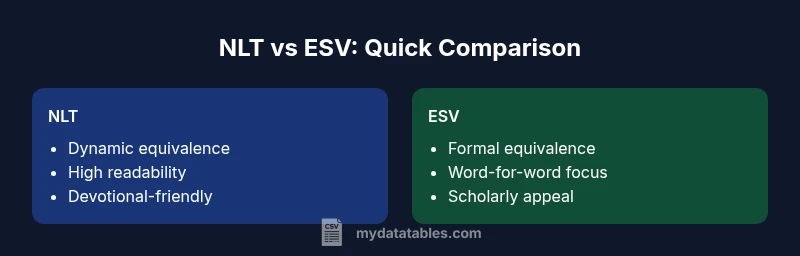
The NLT prioritizes readability through dynamic equivalence, which means translators aim to convey meaning and tone in a way that reads smoothly in contemporary English. This often results in sentences that flow naturally, with interpretive phrases that make the text easier to grasp during personal devotions or group discussions. The ESV prioritizes fidelity to original wording and structure, pursuing formal equivalence where possible. That approach yields a text that reads more like an English rendition of the underlying languages, with sentence construction that can resemble the source syntax. The choice between nlt vs esv frequently hinges on whether the reader needs accessible language or closer textual alignment for word studies and cross-references. Both translations are the product of careful scholarship, manuscript comparison, and ongoing revision. In 2026, publishers and study groups continue to update notes and resources, reflecting new manuscript evidence and user feedback to balance readability with accuracy.
blockID 1
Comparison
| Feature | NLT | ESV |
|---|---|---|
| Translation philosophy | dynamic equivalence (readable, meaning-focused) | formal equivalence (closer to original languages) |
| Primary goals | ease of understanding for a broad audience | precision and trustworthiness for study and exegesis |
| Readability | generally very readable with contemporary phrasing | often more syntactically dense and precise |
| Study aids/footnotes | footnotes and cross-references emphasize meaning and context | footnotes and cross-references emphasize lexical-phrasal fidelity |
| Typical audience | devotional readers, new and casual readers | students, pastors, scholars, and serious readers |
Pros
- NLT prioritizes readability, making scripture accessible for daily devotions and group study
- ESV provides closer alignment to source texts, aiding exegesis and sermon prep
- Both translations are widely used, with extensive study resources and community support
- Diverse translation teams support ongoing revisions and sensitivity to translation consistency
Weaknesses
- NLT can be less suitable for detailed lexical studies due to interpretive choices in places
- ESV can feel dense or archaic to new readers and casual readers
- Footnotes can be heavy in the ESV, which may disrupt flow in reading
- Some readers may prefer a single-go-to translation, making it harder to justify dual usage
Use both translations strategically: NLT for readability and devotional use; ESV for precise study and exegesis.
If your primary goal is smooth reading and immediate comprehension, start with the NLT. For word studies, cross-reference, and careful interpretation, rely on the ESV. A balanced approach—reading with the NLT and consulting the ESV for deeper study—often yields the most well-rounded understanding.
People Also Ask
What is the main difference between NLT and ESV?
NLT uses dynamic equivalence to prioritize readability, while ESV uses formal equivalence to stay close to the source languages. Both are carefully revised and widely used for different purposes.
NLT focuses on readability; ESV focuses on textual fidelity. Both are trusted, but they serve different study needs.
Who should use the NLT?
The NLT is ideal for devotional reading, family scripture study, and readers who prefer modern language. It communicates meaning clearly and naturally without requiring extensive cross-referencing.
Great for daily devotionals or group Bible study where accessibility matters.
Who should use the ESV?
The ESV is well-suited for serious study, sermon preparation, and cross-language comparisons because of its closer adherence to original wording and syntax.
Best for exegesis and careful analysis where precision matters.
Can I use NLT for study effectively?
Yes, you can use NLT for study, especially when paired with a more literal translation for cross-checking terms and phrases. It’s common to consult both for comprehensive understanding.
NLT works for study when complemented by other translations.
Is there a translation that cross-references original texts well?
Both translations provide study aids, but ESV typically offers closer alignment to original phrasing, which can enhance cross-reference work. Supplementing with notes from other translations is common.
ESV is often preferred for cross-referencing original wording.
Main Points
- Choose NLT for daily reading and accessibility
- Choose ESV for study, exegesis, and cross-referencing
- Use both translations to gain broader scriptural insight
- Rely on the right tool for the right task in 2026