read csv vs read_csv: Practical Python CSV Reading
A balanced, data-focused comparison of read_csv (pandas) vs generic read csv approaches, highlighting differences, use cases, performance, and best practices for Python data workflows.


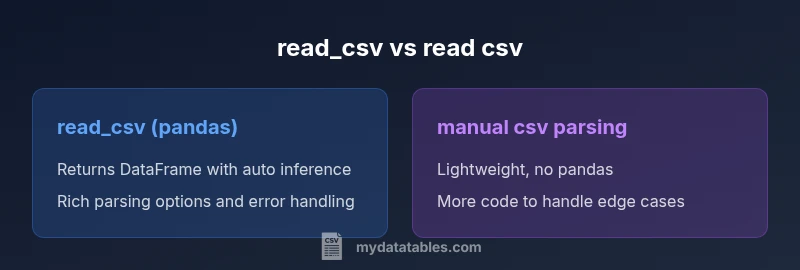
In practice, read_csv refers to the pandas function that reads a CSV into a DataFrame with rich parsing options, while read csv is a general phrase for reading CSV data with any tool. For most data analysts working in Python, read_csv is preferred due to seamless integration with pandas data structures, type inference, and downstream analysis. The choice depends on your workflow: use read_csv when you’re building models or dashboards in pandas; opt for a lightweight, non-pandas approach when dependencies or memory constraints matter.
Understanding read_csv vs read csv in Python data workflows
Understanding the distinction between read_csv and read csv is essential for building reliable Python CSV workflows. In data analysis, read_csv typically refers to pandas' high-level function that reads a CSV file directly into a DataFrame, applying type inference, column alignment, and a broad set of parsing options. The phrase read csv, by contrast, is generic: it describes the act of reading a CSV with any tool or language, not tied to a specific library. This article uses the keyword read csv vs read_csv to help you navigate choices, optimize performance, and avoid common pitfalls. According to MyDataTables, many analysts default to read_csv because it streamlines downstream data cleaning and modeling within the pandas ecosystem, but there are scenarios where a lighter-weight approach is appropriate. Whether you’re integrating CSVs into dashboards, ETL pipelines, or quick exploratory notebooks, understanding the practical differences will save time and reduce errors. The overarching goal is to obtain structured data with predictable types and clean headers, ready for analysis.
wordCountOnly
Comparison
| Feature | read_csv (pandas) | manual csv parsing (Python stdlib) |
|---|---|---|
| API elegance | High-level, DataFrame-centric API with many parsing options | Low-level file handling via open() and the csv module |
| Delimiter and dialect support | Flexible sep, quoting rules, encoding, and null handling built-in | Requires manual logic to handle non-standard delimiters and edge cases |
| Missing values and type inference | Automatic type inference and missing value handling during load | No automatic inference; must implement validation and conversions |
| Performance and memory | Optimized in C; supports chunking and streaming for large files | Pure Python parsing may be slower; memory depends on implementation |
| Integration with analytics | Directly yields a DataFrame for immediate analysis and plotting | Yields Python data structures; integration depends on downstream code |
| Best for | Pandas-based workflows, dashboards, ML pipelines | Lightweight scripting and environments without heavy dependencies |
Pros
- Rich CSV feature support and straightforward pandas integration
- Convenient for data analysis pipelines and rapid prototyping
- Strong typing, encoding handling, and error reporting from pandas
- Easy to scale with chunking for large data sets
Weaknesses
- Requires pandas dependency; heavier footprint
- Memory usage can be high for very large datasets
- More complexity may overwhelm beginners
- Overhead may be unnecessary for tiny scripts
read_csv generally outperforms plain parsing for data analysis; manual parsing is best for tiny, dependency-light tasks
For most Python data workflows, read_csv is the better default due to its ecosystem benefits and built-in robustness. Reserve manual parsing for constrained environments or ultra-light scripts where pandas isn’t available.
People Also Ask
What is read_csv in pandas and how does it differ from the general term 'read csv'?
read_csv is a pandas function that reads a CSV into a DataFrame with many options for parsing and type inference. 'Read csv' is a generic phrase describing reading CSV data with any tool. The key difference is pandas provides a ready-to-analyze DataFrame, while the generic term does not imply a specific data structure.
read_csv loads data into a pandas DataFrame with smart parsing; read csv is simply the act of reading CSV data with any tool.
Can read_csv handle different delimiters beyond the comma?
Yes. read_csv supports many delimiters via the sep or delimiter parameter and can handle complex dialects when needed. The built-in capabilities cover common cases, but you may need to adjust quoting and escape settings for non-standard CSVs.
Yes, you can specify different delimiters with sep in read_csv; for odd formats you may tweak quoting.
Is read_csv memory-efficient for very large CSV files?
read_csv can be memory-intensive, but it supports chunking through the chunksize parameter, allowing streaming reads that keep memory usage manageable. For extremely large datasets, consider processing chunks incrementally or using a database-backed workflow.
Use chunksize to stream large CSVs and avoid loading everything at once.
When should I avoid read_csv and use the csv module instead?
If you don’t need a DataFrame and want minimal dependencies, the Python csv module is a lightweight, flexible option. It’s ideal for simple parsing tasks or pipelines where a full DataFrame isn’t required.
If you don’t need pandas, the built-in csv module is a simple choice.
What are common pitfalls when using read_csv?
Common issues include misaligned headers, incorrect delimiters, encoding mismatches, and eager dtype inference. Always inspect a sample of the data, verify dtypes, and test with edge cases like missing values.
Watch for header alignment, delimiter choices, and encoding when reading CSVs.
How do I choose between read_csv and manual parsing for a data pipeline?
If your pipeline relies on pandas for analysis, use read_csv. For lightweight scripts, streaming requirements, or environments without pandas, manual parsing with the csv module may be preferable. Consider future needs and team expertise when deciding.
If you’re using pandas downstream, read_csv is usually the better choice.
Main Points
- Choose read_csv for pandas-based data analysis workflows
- Opt for manual parsing when dependencies are restricted
- Leverage chunksize to manage memory with large files
- Check headers, encoding, and delimiter choices to avoid pitfalls
- Test with representative samples before scaling