CSV vs ESV Bible: A Practical, Data-Text Comparison
A rigorous, data-focused comparison of CSV data formats and the ESV Bible translation. Explore use cases, encoding, and best practices to guide your workflow.


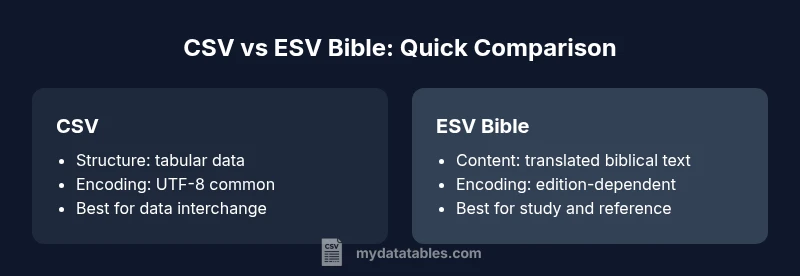
CSV and the ESV Bible serve distinct purposes: CSV is a lightweight, tabular data format ideal for storage, interchange, and analysis; the ESV Bible is a translated text designed for study and reading. For decision-making, choose the format that matches your goal: data operations versus textual study.
CSV vs ESV Bible: Context and scope
When people first encounter the phrase csv vs esv bible, it becomes clear that these two things belong to different domains: a data format and a translation of scripture. For data scientists, analysts, and developers, CSV is a simple, portable representation of tabular data—rows and columns that can be opened in spreadsheets or loaded into databases. For students, pastors, and lay readers, the ESV Bible offers a carefully translated English text intended for study, devotion, and classroom discussion. According to MyDataTables, recognizing this fundamental divide is the first step to avoiding quality traps and misapplied techniques. The rest of this article places these items on equal footing as objects of analysis, not as interchangeable assets. We will explore use cases, encoding, access patterns, and quality considerations that influence when you choose one format over the other. Throughout, keep in mind that csv vs esv bible is best understood as a comparison of data-oriented versus text-oriented tasks.
Defining CSV and the ESV Bible
CSV is a plain-text format that stores tabular data in rows and columns, using a delimiter (commonly a comma) to separate fields. It is prized for simplicity, portability, and wide tool support. The ESV Bible is a modern English translation of the Christian Bible, designed for readability, accuracy, and scholarly study. It exists in multiple editions and formats (print, digital, audio), each with its own editorial choices and licensing. Comparing csv vs esv bible highlights two very different kinds of information: structured data versus structured words and meanings. In practice, CSV files often encode numbers, dates, and identifiers, while the ESV Bible encodes verses, chapters, and cross-references that support interpretation and discourse.
About scope and audience
The CSV world speaks to data engineers, analysts, and software developers who need reliable interchange formats. The ESV Bible speaks to theologians, educators, and lay readers who want accurate, accessible scripture. This divergence in audience shapes how each format handles quality, verifiability, and updates. The MyDataTables framework encourages readers to distinguish these domains early to prevent misguided attempts to apply data techniques to textual translations, or vice versa.
Core differences: data structure vs language content
CSV organizes information into a grid: records (rows) and fields (columns). This structure enables deterministic parsing, simple validation rules, and straightforward relational operations. In contrast, the ESV Bible is a continuous text with chapters and verses, where meaning emerges from linguistic choices, translation decisions, and contextual interpretation. The csv vs esv bible contrast underscores a broader principle: data formats excel when structure and interchangeability matter, while translated texts excel when nuance, fidelity, and interpretation are the goals. Understanding these core differences helps teams decide early which format to invest in for a given task.
Encoding, standards, and quality considerations
Encoding choices matter in both domains, but their implications differ. CSV files are often encoded in UTF-8 to preserve characters across languages and scripts, and they benefit from consistent quoting rules to avoid misparsing. The ESV Bible edition you use may specify different font encodings, punctuation conventions, and verse numbering schemes, which can affect search, alignment, and cross-referencing. Quality control in CSV work emphasizes schema validation, data types, and edge-case handling (empty fields, quoted delimiters). In Bible translation, quality concerns include fidelity to source texts, consistency of translation choices, and alignment with edition-specific features (footnotes, cross-references). Awareness of these standards helps maintain integrity when loading CSV data into analytics pipelines or studying biblical passages in a digital library.
Searchability and indexing: how easy is it to query each format?
CSV supports fast, deterministic lookups by key fields and straightforward filtering via standard query operators. When you need to join data across tables or compute aggregates, CSV often shines in pipeline stages that feed into databases or analytics engines. The ESV Bible presents a more complex search problem: verse-based indexing, thematic tagging, and cross-references require specialized text indexing, morphological analysis, and edition-aware parsing. CSV excels at numeric and categorical queries, while Bible study benefits from verse-level search, concordances, and edition-aware retrieval. The upshot is that each format relies on different indexing strategies to achieve fast results.
Practical implications for data analysts and researchers
If your goal is to extract insights from structured data, csv vs esv bible generally favors CSV as the starting point due to its predictability and tooling support. You can clean, transform, and analyze CSV data with minutes rather than hours, especially when the data adheres to a fixed schema. For researchers focusing on textual study, the ESV Bible offers depth and context that CSV cannot replicate without substantial layering (e.g., embedding verse metadata, cross-references, and linguistic annotations). In many teams, both formats co-exist: CSV for data pipelines and ESV Bible resources for study modules. The practical lesson is to map tasks to formats, not force a single approach across all activities.
Real-world workflows: data pipelines vs study workflows
In a typical data workflow, CSV serves as the ingestion layer for dashboards, ETL jobs, and machine-learning pipelines. You might import CSV into a data warehouse, perform joins to enrich records, and output results as CSV or parquet. In a study workflow, the ESV Bible is consulted for translation accuracy, linguistic research, and sermon preparation. Technologists might extract verses or annotations into CSV for cross-referencing with other texts, but this is an augmentation rather than a replacement for the original textual material. The csv vs esv bible comparison helps stakeholders design workflows that respect the strengths of each format.
Practical guidance for teams working with both formats
Teams should establish a clear task-ownership map: data tasks assigned to CSV workflows, textual study tasks assigned to Bible editions and study tools. Adopting a hybrid approach can yield the best of both worlds: CSV for reproducible data stories and ESV Bible resources for faithful interpretation. Documentation should spell out how versions and editions are chosen, how encoding is handled, and how cross-references are reconciled. By separating concerns, teams reduce the risk of misapplying data techniques to text and vice versa, while ensuring both formats are leveraged where appropriate.
Comparison
| Feature | CSV data format | ESV Bible translation |
|---|---|---|
| Primary use | Structured data interchange and analysis | Study, reading, and reference translation |
| Content type | Rows and columns with fields | Biblical text with verses and chapters |
| Encoding considerations | UTF-8 widely used; delimiter handling critical | Edition/print may have edition-specific typography and encoding |
| Searchability | Efficient numeric/categorical queries; indexable by keys | Verse-level indexing; cross-references and notes vary by edition |
| Best for | Data pipelines, dashboards, analytics | Theological study, sermon prep, devotional reading |
Pros
- Clear separation of data and textual content supports specialized tooling
- CSV enables fast, deterministic data processing and exchange
- ESV Bible editions provide faithful translation and study-friendly formatting
Weaknesses
- Fundamental domain mismatch can cause misapplications if combined loosely
- CSV lacks inherent textual semantics without additional metadata
- Bible editions vary; translation choices may affect cross-reference work
CSV for data tasks; ESV Bible for study and translation
When your goal is data analysis or interchange, CSV is the durable choice. For scholarship and devotional study, the ESV Bible edition offers richer semantic context and fidelity.
People Also Ask
What is CSV and what is the ESV Bible?
CSV is a plain-text format for tabular data, using delimiters to separate fields. The ESV Bible is a modern English translation of Scripture designed for study and reading. The csv vs esv bible comparison highlights two fundamentally different types of information and usage.
CSV stores rows and columns; the ESV Bible stores translated passages. They serve different purposes—data analysis versus study of scripture.
Can Bible text be stored in CSV format?
Yes, Bible text can be stored in CSV by organizing verses as records with fields like book, chapter, verse, and text. However, doing so requires careful schema design and may complicate cross-references and angle-based searches.
Bible text can be encoded in CSV, but it often needs careful schema and indexing to be effective.
What are the main use cases for CSV vs ESV Bible?
CSV is ideal for data integration, reporting, and analytics across systems. The ESV Bible is optimal for study, teaching, and devotional reading. The key is aligning the task with the format’s strengths rather than forcing one format to cover both domains.
CSV for data tasks; ESV Bible for study and teaching.
How do encoding and edition differences affect these formats?
UTF-8 encoding helps preserve characters in CSV, but delimiter handling and quoting rules must be consistent. Bible translations depend on the edition; verse numbering and footnotes can vary between editions, influencing search and cross-referencing.
Encoding matters; edition differences affect search and references.
When should analysts choose CSV vs Bible translations in projects?
Choose CSV when the project involves structured data manipulation, aggregation, or data sharing. Opt for a Bible translation when the goal is textual study, theological analysis, or devotional use, and align with the edition’s features.
Choose based on whether you need data manipulation or textual study.
What are common pitfalls when mixing data formats and texts?
Avoid treating Bible text as structured data without metadata and consistent tokenization. Likewise, don’t expect raw CSV to provide semantic meaning or translation nuance. Always document versioning, encoding, and schema choices.
Be careful not to mix data semantics with texts without metadata.
Main Points
- Match format to task: data vs text
- Use UTF-8 with consistent delimiter handling in CSV
- Choose edition-aware Bible tools for study and cross-references
- Separate data pipelines from textual study to avoid misapplications
- Plan encoding, metadata, and versioning early in projects