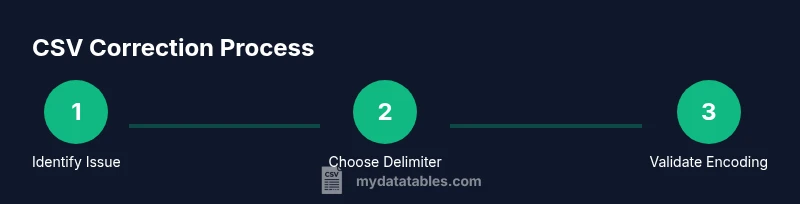
How to Correct CSV Format: A Practical Guide
Learn reliable steps to fix common CSV formatting issues, including delimiters, headers, encoding, and quotes, with practical workflows for Excel, Python, and automation.


This guide shows you how to correct CSV format by validating delimiters, headers, quotes, and encoding. You will learn how to inspect a file for common issues, choose the right delimiter, fix misquoted fields and embedded newlines, preserve data integrity, and re save with a consistent encoding. Practical workflows cover Excel, Python, and command line tools.
Why correct CSV format matters
CSV files are a backbone for data sharing among analysts, developers, and business users. When format is inconsistent or broken, downstream systems misinterpret values, migrate data incorrectly, or fail to load entirely. According to MyDataTables, precise CSV formatting saves hours of data cleaning and prevents misleading analyses. The MyDataTables team found that even small deviations in delimiters, quotes, or encoding can cascade into errors across import pipelines. A well formatted CSV has a single delimiter, a clear header, stable quoting rules, and consistent encoding. This consistency enables reliable parsing in databases, spreadsheets, and data transformation tools. Investing in CSV quality pays off with reproducible results, smoother automation, and fewer manual fixes in ongoing projects.
Common CSV format issues
Many CSV problems come from simple oversights:
- Mixed delimiters (commas in some rows, semicolons in others)
- Missing or duplicated header rows
- Misplaced or inconsistent quotes
- Embedded newlines within fields
- Leading or trailing spaces that alter values
- Mixed encodings or a BOM in UTF-8 files
- Inconsistent row lengths or trailing delimiters
- Non standard line endings (CRLF vs LF)
- Special characters not handled correctly
- Files saved with non UTF-8 encoding or with a restricted charset
These issues can be subtle but highly disruptive. A systematic approach to identify and correct them will save time and prevent data quality problems later in the pipeline.
Planning your correction approach
Before touching the data, plan a safe, repeatable workflow. Start with a full backup of the original CSV. Decide on the final delimiter you will use and ensure every row follows that choice. Confirm the encoding you will adopt, and establish a consistent quoting policy for values that contain delimiters or line breaks. Map each column to an expected data type to catch mis typed values early. Document the corrections you make so teammates can reproduce or audit the changes. A well documented plan reduces confusion and supports maintenance across teams.
Detecting problems with your CSV
To detect issues, begin with a quick visual scan in a plain text editor to spot irregularities in line endings, quotes, and headers. Use a scripting language or a validator to parse a sample of lines and report anomalies such as uneven field counts or invalid quotes. If you have Python, pandas read_csv with a trial delimiter can reveal mismatches. Spreadsheet tools can also expose problems when importing data. Early detection helps you choose the right correction strategy and avoid overhauling the entire file.
Correcting delimiters and quotes
Choose your final delimiter and replace inconsistent separators across the file. If you work with a region that uses semicolons, switch to comma or vice versa using a robust editor or a small script. Normalize quotes so that fields containing the delimiter or newline are properly enclosed. Prefer a consistent rule: quote fields that contain the delimiter, quote, or newline, and escape embedded quotes inside a field. After corrections, recheck a subset of rows to ensure that parsing remains stable.
Aligning headers and data types
Verify the first line is a genuine header with consistent column names. If a header is missing, create one and align every subsequent row to the same column order. Normalize data types by inspecting representative rows for each column and converting strings to numbers or dates where appropriate. Avoid mixed types in a single column, as this harms downstream processing. A consistent header and typed data reduce errors during loading into databases or analytics tools.
Encoding and BOM handling
Encoding consistency is critical for reliable data transfer. Save the file as UTF-8 or another agreed encoding, and decide whether to include or omit a Byte Order Mark (BOM) depending on downstream systems. UTF-8 without BOM is a common default that avoids many issues. If non ASCII characters appear as garbled text, re saving with the correct encoding typically resolves the problem. Validate a sample through a validator to confirm compatibility across platforms.
Practical tools and workflows
For quick fixes, spreadsheet software can often fix delimiter and header issues by re importing with a specified delimiter and exporting again. Python offers powerful options with pandas read_csv and to_csv to enforce a single delimiter and encoding. Command line tools like awk or sed can perform batch edits on large files. Establish a repeatable workflow by scripting the steps you routinely perform and running validations after each run. This makes CSV correction scalable and repeatable.
Validation and testing
After correction, validate with an automated checker or validator service to catch residual problems. Ensure that all rows have the same number of fields and that encoding is preserved. Import the CSV into a test environment to confirm that keys, constraints, and data types behave as expected. If problems persist, isolate failing rows and examine the surrounding data to determine whether a mis formatted field or corrupted chunk caused the issue.
Automating corrections and best practices
Automate routine CSV corrections with small scripts or pipeline steps to maintain consistency across files and projects. Enforce a single delimiter and encoding as a project standard. Maintain a changelog of edits to support auditing and reproducibility. Use validation steps in CI pipelines to catch regressions early. By adopting a consistent approach, teams can reduce data cleaning time and increase confidence in CSV based workloads.
Tools & Materials
- Text editor or IDE (VS Code, Sublime, Notepad++)(Useful for quick delimeter checks and manual edits)
- Spreadsheet software (Excel, Google Sheets)(Helpful for visual import and quick re export)
- Python 3.x environment with pandas(Recommended for robust parsing and automation)
- CSV validation tool or online validator(Used to verify delimiter, quotes, and encoding)
- Sample CSV dataset(For practice and testing corrections)
- Command line utilities (awk, sed)(Optional for batch edits on large files)
Steps
Estimated time: 60-90 minutes
- 1
Back up the original file
Create a copy of the CSV before making any changes. This protects you from data loss if corrections go wrong and supports traceability.
Tip: Store backups in a separate folder with a timestamp - 2
Identify the current delimiter
Open the file in a plain text editor and look for the character separating fields. If uncertain, try parsing with common delimiters (comma, semicolon, tab) until the data lines up.
Tip: Try a small sample of lines to test each delimiter quickly - 3
Standardize quotes and embedded characters
Ensure that fields containing the delimiter or newline are properly quoted. Check for unbalanced quotes that can break parsing.
Tip: If a field has quotes inside, escape them consistently - 4
Check headers and column order
Verify the first row is a header with unique, consistent column names and that every subsequent row has the same number of fields as the header.
Tip: If a header is missing, add one and align all rows - 5
Fix encoding and BOM
Decide on UTF-8 as the standard encoding and rewrite the file without or with a BOM as required by downstream systems.
Tip: If characters appear garbled, re save with UTF-8 encoding - 6
Re save using a single delimiter
Export or write the corrected data using a single chosen delimiter, ensuring uniform application across the file.
Tip: Avoid mixing delimiters in future exports - 7
Validate corrected CSV
Run a validator to confirm correct field counts, quotes, and encoding. Check for any edge cases with special characters.
Tip: Validate with a sample load into downstream systems - 8
Test downstream import
Import the corrected file into a test environment to confirm that expected columns map correctly and data types align.
Tip: Document any issues found during import
People Also Ask
What counts as a correct CSV format?
A correct CSV format uses a single delimiter, a clear header, consistent quoting, and a stable encoding such as UTF-8. Each row should have the same number of fields as the header, and values containing the delimiter or newline must be properly quoted.
A correct CSV has one delimiter, a clear header, consistent quotes, and UTF-8 encoding. Every row matches the header in field count.
How do I identify delimiter mismatches?
Open the file in a text editor and inspect several lines to see if fields break consistently at the same character. If lines seem to have different numbers of fields, test with common delimiters such as comma and semicolon until the structure aligns.
Look for lines that break differently. Try comma and semicolon until the count matches across rows.
Can I fix encoding issues automatically?
Yes. Save the file in UTF-8 and avoid BOM if downstream systems prefer it. If non ASCII characters appear garbled, re saving with the correct encoding typically resolves the problem.
You can fix encoding by saving as UTF-8 and avoiding BOM if needed. Re saving usually resolves garbled characters.
Should I always use UTF-8 for CSV files?
UTF-8 is widely recommended because it supports all Unicode characters. Some systems have strict limits; in those cases you may adapt but aim for a universal encoding when possible.
UTF-8 is generally best. Some systems may require other encodings, but UTF-8 covers most cases.
What tools can automate CSV cleaning?
Scripts using Python with pandas or simple command line tools can automate delimiter normalization, quoting, and encoding checks. Validators and CI pipelines can enforce ongoing CSV quality.
Use Python scripts or command line tools to automate cleaning, and add validators in your CI pipeline.
How can I validate the corrected CSV?
Run a validator that checks field counts, quotes, and encoding. Import the file into a test environment to confirm data mapping and types behave as expected.
Validate with a checker and test import to ensure correct mapping.
Watch Video
Main Points
- Back up before edits and document changes
- Choose a single delimiter and encoding for consistency
- Validate with automated checks and test imports
- Use scripting to automate repetitive corrections