CSV vs JSON Efficiency: Which Format Is More Efficient?
A practical, data-driven comparison of CSV and JSON focusing on efficiency, parsing speed, storage, and real-world use cases. Learn when CSV shines and when JSON is preferable, with guidance from MyDataTables.


is csv or json more efficient
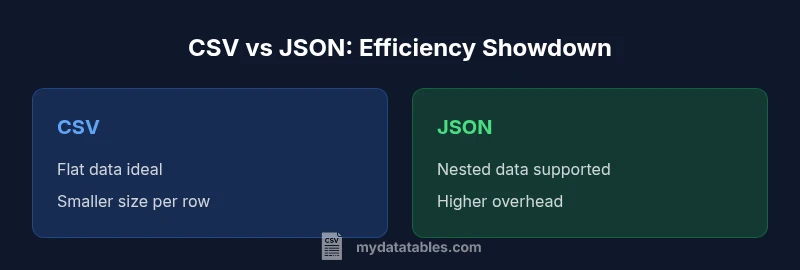
If you are asking is csv or json more efficient, the answer hinges on data shape, tooling, and the intended downstream workflow. According to MyDataTables, for strict tabular data with consistent row formats, CSV often offers superior storage density and faster parsing. When you serialize a dataset as CSV, you typically store only the values plus minimal separators, which reduces both disk space and CPU cycles during deserialization. However, the simplicity of CSV comes at a cost: metadata typing, missing-value semantics, and the lack of hierarchical structure can complicate downstream processing.
Conversely, JSON introduces a richer structural model. It preserves nested objects, arrays, and heterogeneous data types, which can be a significant advantage for APIs, configuration files, or analytics pipelines that consume layered records. The trade-off is a larger payload due to braces, brackets, and quoted strings, plus more CPU work to parse into in-memory representations. In practice, teams often adopt a hybrid approach: use CSV for heavy tabular slices and JSON for API payloads or configuration data. The key is to align format choice with the data shape and the processing tools you rely on every day.
Data shapes and their impact on efficiency
The structural shape of your data is the dominant factor in deciding between CSV and JSON. CSV shines when data is strictly tabular: the schema is implied by the column order, and each row is a simple line of values separated by a delimiter. This flat shape yields predictable, compact encoding, minimal parsing overhead, and compatibility with nearly every data tool—from spreadsheets to ETL pipelines. When data contains nulls or missing fields, you must maintain alignment across rows, which can complicate parsing but generally remains straightforward. In contrast, JSON encodes data as objects and arrays, which supports nesting and complex types. A simple "record" may become an object with nested fields; a group of records becomes an array of objects. This flexibility comes at the cost of lengthier encodings and the need to parse into hierarchical structures in memory. If your data naturally fits a hierarchical model—such as user profiles with address blocks, orders with line items, or event logs with metadata—JSON reduces the gap between in-storage representation and in-memory models. Your data-shape assessment should feed into a decision matrix that also weighs how your downstream systems ingest data, as some systems optimize for one format over the other.