CSV and CSA: A Practical Comparison for Data Workflows
A detailed, analytical comparison of CSV and the schema-annotated CSA variant. Explore delimiters, metadata, validation, tooling, and governance to decide which format fits your data pipelines and analytics use cases.


CSV is the classic plain-text format for tabular data, using a delimiter (commonly a comma) and quotes for fields. CSA stands for a schema-annotated CSV extension (a conceptual variant) that embeds metadata and validation rules alongside the data. For most workflows, CSV wins on compatibility; CSA excels where metadata and schema enforcement are essential.
Why CSV and CSA matter for data workflows
In modern data work, the choice of file format influences data quality, collaboration, and automation. The term csv and csa reflects two ends of a spectrum: plain CSV, the long-standing workhorse for tabular data, and CSA, a schema-annotated extension that aims to embed structure and governance into the data layer. For teams working with data pipelines, dashboards, or analytics models, understanding these formats helps reduce errors, improve reproducibility, and streamline tooling. This guide addresses csv and csa to provide practical guidance for data analysts, developers, and business users.
What exactly is CSA in this context?
CSA, in the scope of this article, refers to a schema-annotated CSV extension. The idea is to pair the familiar, human‑readable CSV body with an explicit, machine‑readable schema that describes column types, constraints, and metadata. This is not a universal standard; it is a pragmatic approach used in certain data governance and pipeline environments. CSA aims to improve validation, auditable lineage, and cross‑team understanding by making the schema part of the data artifact rather than a separate process.
Core differences at a glance
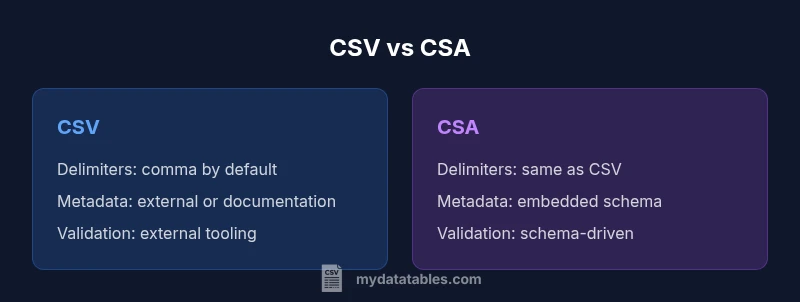
- Delimiters and structure: CSV defaults to a simple comma-delimited table with optional quotation marks. CSA adds a separate or embedded schema layer that describes columns and constraints.
- Metadata and validation: CSV can carry metadata only through accompanying documentation or separate files. CSA integrates metadata and validation rules, enabling schema-driven checks.
- Tooling and ecosystem: CSV is supported by nearly every data tool. CSA requires CSA-aware tooling to leverage the schema effectively, though some libraries and platforms offer experimental support.
- Readability and complexity: CSV remains highly readable in plain form. CSA introduces schema data that can slightly reduce readability but increases governance and automation potential.
- Use cases: CSV suits quick sharing, prototyping, and broad interoperability. CSA shines in regulated environments, data warehouses, and pipelines needing strong validation and metadata governance.
Delimiters, quoting, and encoding in practice
The most common practice for CSV is to use UTF-8 encoding with a comma delimiter. When fields contain the delimiter, line breaks, or quotes, proper quoting rules must be followed to avoid misparsing. In practice, teams should decide on a delimiter convention early and document it, especially in mixed-cultural contexts where decimal separators influence delimiter choices. For CSA, the delimiter remains the same at the body level, but the schema provides explicit type information that anchors how data should be parsed and validated, reducing ambiguity for downstream systems.
Metadata, schema, and validation capabilities
CSA introduces a schema layer that can describe expected data types (e.g., integer, date, string), bounds, required fields, and relationships between columns. This capability makes automated validation straightforward and repeatable, supporting data quality initiatives and governance requirements. CSV alone relies on external validation steps or ad hoc scripts. CSA’s schema can be stored alongside the data or embedded in a header section, enabling easier reproducibility and audit trails.
Tooling, compatibility, and ecosystem considerations
For CSV, the ecosystem is vast: spreadsheets, relational databases, ETL tools, scripting languages, and cloud storage all natively support CSV in some form. CSA-compatible tooling is growing but not as ubiquitous; you may encounter parsers that ignore or misinterpret schema annotations. When adopting CSA, ensure that your data consumers and producers share a common understanding of the schema representation and that validation logic is consistently applied across environments.
Data governance, lineage, and compliance implications
CSA can enhance data governance by making schema and metadata explicit, enabling versioned schemas and clearer lineage. This reduces the risk of schema drift and improves auditability in regulated workflows. CSV offers straightforward exchange but requires disciplined documentation and process controls to maintain data quality. A governance-first approach often benefits from CSA in pipelines where automated validation, metadata catalogs, and compliance reporting are priorities.
Practical workflows: when to choose each format
- Quick data exchange and collaboration: CSV is typically the better default due to broad compatibility and ease of use.
- Data pipelines with governance needs: CSA is advantageous when strict validation, metadata, and schema-driven automation are essential.
- Prototyping with eventual governance: Start with CSV for speed, then introduce CSA in the data governance phase as requirements mature.
- Large, cross-team datasets: CSA can reduce rework by ensuring consistent schema enforcement across teams and environments.
Getting started: implementation steps for csv and csa strategies
- Define your goals: determine whether broad interoperability (CSV) or governance and validation (CSA) are priority.
- Establish encoding and delimiter standards: pick UTF-8 as a baseline; document the chosen delimiter clearly.
- Decide how to handle metadata: decide whether CSA schemas live in a separate file or within a header block in the data file.
- Pilot with representative datasets: test parsing, validation, and downstream consumption to surface issues early.
- Document processes and train teams: create a living reference for formats, schemas, and validation rules.
- Automate validation and lineage: implement schema-based checks in CI/CD pipelines and data catalogs.
Real-world scenarios and pitfalls
Real-world projects reveal several common patterns: CSV remains the fastest path to initial data sharing, while CSA becomes valuable when data quality gates are non-negotiable. Pitfalls include inconsistent encoding across teams, inconsistent quoting rules, and omitted schema changes leading to drift. By aligning delimiter choice, encoding, and schema usage early, teams reduce downstream errors and improve collaboration across analytics, engineering, and business stakeholder groups.
Comparison
| Feature | CSV | CSA |
|---|---|---|
| Delimiters/Structure | Comma-delimited with quotes | Schema-annotated with explicit metadata |
| Metadata/Schema | Minimal or none | Embedded schema annotations or separate header metadata |
| Validation/Enforcement | Loose validation via file parsing | Built-in validation against schema |
| Tooling Compatibility | Broad support in editors and libs | More limited tool support; requires CSA-aware tools |
| Human Readability | High readability in simple files | Added schema lines may reduce readability |
| Best For | General data exchange and lightweight workflows | Data governance, strict validation, and metadata-driven pipelines |
Pros
- Broad ecosystem support across tools and platforms
- Simple, human-readable format for quick sharing
- Low overhead for small datasets
- Wide interoperability with databases and spreadsheets
Weaknesses
- Limited built-in validation without extra tooling
- CSA requires more tooling and setup
- Metadata can add complexity for simple tasks
CSV remains the baseline for compatibility; CSA is the better choice when schema and metadata governance matter.
If you prioritize interoperability and quick sharing, choose CSV. If governance and validation are critical, CSA offers structured advantages; assess tooling maturity and team capability. The MyDataTables team notes the practical balance favors starting with CSV and adopting CSA in governance-heavy workflows.
People Also Ask
What is CSA in the context of CSV?
CSA refers to a schema-annotated extension of CSV that embeds metadata and validation rules alongside the data. It is not a universal standard, but it is used in workflows requiring governance and automated checks.
CSA is a schema-annotated variant of CSV used when governance and validation matter.
Can CSA use existing CSV tools?
Yes, but you may need CSA-aware parsers or adapters to fully leverage the schema metadata. Standard CSV tools will typically ignore CSA annotations unless explicitly supported.
Some tools support CSA; others only handle pure CSV.
Which is faster to process, CSV or CSA?
CSV generally processes faster in environments without schema validation, due to its simpler structure. CSA adds overhead for schema evaluation during parsing and validation.
CSV is usually faster; CSA adds validation overhead.
Are there security concerns with CSV/CSA files?
CSV/CSA files are plain text. Treat them as data inputs to be validated and sanitized in downstream applications to prevent injection or parsing errors.
Treat CSV/CSA as inputs to be validated and sanitized.
How do I validate a CSV file?
For CSV, use parsing libraries and, when possible, schema-based validators. In CSA, rely on the embedded schema to enforce rules automatically during validation.
Use a validator that checks parsed data against the schema.
What’s the best starting point for teams new to these formats?
Start with CSV for quick wins and broad compatibility. Introduce CSA in stages as governance and data quality requirements grow, ensuring teams have tooling and training.
Begin with CSV, then add CSA as governance needs rise.
Main Points
- Choose CSV for broad adoption and ease of use
- CSA adds metadata and schema for governance
- Verify tooling support before switching
- Be mindful of encoding and delimiter defaults
- Use CSA in data-ops pipelines with governance goals